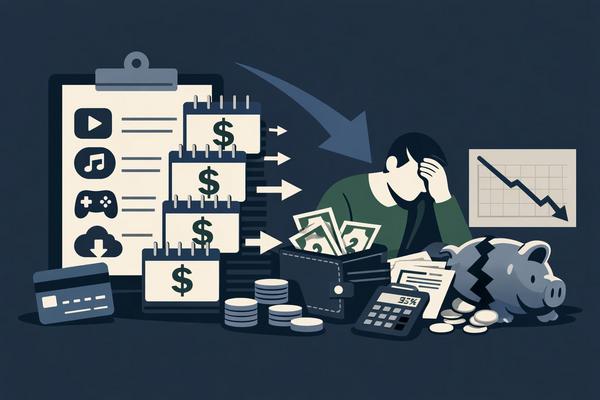
Your card gets charged all month long, and somehow your checking account is empty again before payday.
Subscription costs and budget problems usually don’t come from one big mistake. They come from a bunch of small charges you barely notice anymore. A streaming app here, cloud storage there, a meal app you meant to cancel, a free trial that quietly turned into $14.99 a month. On their own, none of them feel like a crisis. Added together, they can easily eat up hundreds of dollars a year and make your monthly cash flow feel tighter than it should.
If you’ve looked at your bank statement and thought, “Why am I always short even though I’m not buying anything crazy?” — this is one of the first places to look. Recurring charges are sneaky because they blend into the background. They’re automatic, familiar, and usually small enough that your brain files them under “fine.” That’s exactly why they pile up for so long without getting challenged.
Why Subscriptions Feel Cheaper Than They Really Are
Most subscriptions are sold in monthly terms because monthly sounds harmless. Ten bucks a month doesn’t hit the same way as $120 a year, even though it’s the same money. Companies know that. They also know you’re more likely to say yes to a small recurring charge than a bigger one-time purchase. Your budget doesn’t experience these costs one at a time — it experiences all of them at once.
That’s where the cash flow drain happens. Your rent, groceries, gas, insurance, and minimum debt payments already take the first bite out of your paycheck. Then the subscriptions start pulling money in the background. Maybe it’s $9.99, then $12.99, then $6.99, then $19.99, then another annual renewal you forgot was coming. None of those charges seems big enough to stress over, but together they can be the reason you keep moving money from savings or swiping a credit card for basic stuff at the end of the month.
A one-time $180 purchase makes you stop and think. Eighteen separate charges of around ten bucks usually don’t. Small recurring costs are dangerous because they don’t ask for your attention every time they take your money.
It’s Not About Waste — It’s About Forgotten Spending
A lot of people feel guilty when they look at their subscriptions. They assume the problem is laziness or bad discipline. Usually, that’s not it. Life moves fast. You sign up to watch one show, grab a delivery perk during a busy month, start a workout app in January, or take a free trial because your kid needed it for school. Then work gets busy, bills stack up, and you stop thinking about it. Most subscription overspending happens because you signed up for a temporary reason and never made a deliberate decision to keep paying.
That distinction matters. You’re not trying to build a perfect, no-fun budget. You’re trying to stop paying for things that no longer earn their spot. The issue is the gap between what you think you’re paying for and what you’re actually paying for. That gap gets bigger because recurring charges hide in different places:
- your debit card statement
- one or two different credit cards
- app store billing
- PayPal or digital wallet charges
- annual renewals that don’t show up every month
When the charges are scattered, it’s hard to see the total. And if you can’t see the total, you’ll almost always underestimate it.
What This Looks Like in a Real Monthly Budget
Let’s say you have these recurring charges:
- Streaming services: $42
- Music and audiobook apps: $26
- Cloud storage and software: $31
- Delivery memberships: $20
- Fitness or wellness apps: $28
- Miscellaneous app subscriptions: $24
That’s $171 a month — $2,052 a year. Even if your total is half that, you’re still talking about real money. Eighty-five dollars a month could cover a chunk of your electric bill, help with groceries, or keep you from carrying a credit card balance into next month. When recurring subscription charges add up, they don’t just cost money — they make the rest of your budget more fragile. A higher gas bill hurts more. A school fee feels like bad timing. A copay turns into a budget problem. That’s why this matters.
If You’ve Never Actually Audited Your Subscriptions, Start Here
You don’t need a complicated system. You need one honest pass through your accounts. Pull up the last two or three months of transactions from every place money leaves your life — checking, all credit cards, app store purchases, and any payment platform you use. Your goal is simple: find every charge that repeats automatically.
As you go, sort each one into one of three buckets:
- Keep it: you use it regularly and would sign up again today
- Pause it: you like it, but you don’t need it right now
- Cancel it: you forgot about it, barely use it, or wouldn’t miss it
That middle category matters more than people realize. A lot of subscriptions aren’t bad enough to cancel forever — they’re just not worth paying for this month. Rotating subscriptions can save a surprising amount without making you feel deprived. You don’t need five streaming services running at the same time.
A Quick Rule That Makes the Decision Easy
If you wouldn’t notice losing the service for 30 days, it probably shouldn’t stay on autopay. That’s a clean test. It’s not perfect, but it cuts through a lot of indecision. If the subscription matters, you’ll re-subscribe on purpose. If it doesn’t, you just stopped a leak.
How to Keep This From Happening Again
The fix isn’t to swear off subscriptions forever. It’s to stop letting them renew without a fresh decision. The easiest way to do that is a simple monthly check-in — ten minutes, same day every month, reviewing recurring charges. A few practical moves help a lot:
- Keep a single note on your phone with every subscription and its monthly or annual cost
- Mark annual renewal dates on your calendar a week before they hit
- Use one main card for subscriptions so they’re easier to track
- Cancel free trials immediately after signing up if you’re only testing them
- Review app store subscriptions separately — those are easy to miss
None of this is fancy. That’s the point. Budget fixes work better when they fit real life, not when they require a spreadsheet you’ll never open again.
The Bigger Lesson Here
Most people underestimate their subscriptions by hundreds of dollars a year — not because they’re careless, but because they signed up and forgot. Once you see that clearly, the goal isn’t to become extreme. Keep the subscriptions that genuinely improve your life. Cut the ones that don’t. Pause the ones that only make sense sometimes. That one shift gives your money more room to actually do something useful instead of disappearing into background charges every month.
If this clicked, the next thing worth looking at is how buy now, pay later spending quietly reshapes a household budget in the same kind of slow, invisible way.