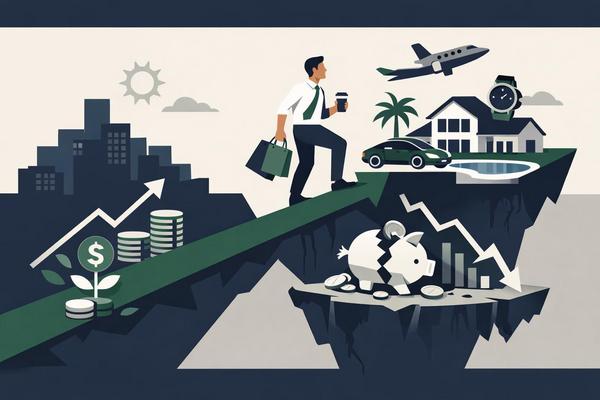
Your paycheck keeps going up, but your savings account still looks exactly the same as it did two years ago.
That gap between earning more and actually feeling ahead is where lifestyle creep does its damage. You get a raise, and suddenly the nicer apartment seems reasonable. The older car starts to feel embarrassing. Dinner out turns into two dinners out, then delivery on weeknights, then a vacation you tell yourself you can finally afford.
Nothing looks reckless on its own, which is exactly why lifestyle inflation is so easy to miss.
If you’ve ever looked at your income and thought, “I make way more than I used to — so why don’t I have much to show for it?” this is probably a big part of the answer. It doesn’t happen because you’re bad with money. It happens because every raise gets quietly claimed by higher monthly costs before it has a chance to build anything real.
The Gap Between Earning More and Getting Ahead
A higher income gives you more options, but it doesn’t automatically make you wealthier. That’s the part a lot of people learn the hard way.
Income is what comes in. Wealth is what stays. If every raise gets converted into better stuff, faster convenience, and bigger recurring bills, your lifestyle improves but your balance sheet doesn’t.
That’s why someone making $70,000 can be building more real financial security than someone pulling in $120,000. The higher earner may have the nicer life on the surface, but if they need every dollar to support that life, they’re not getting ahead in the way that actually matters. Wealth building depends on the gap between what you earn and what you keep — what goes into your 401k, your savings, or toward killing off debt. When that gap stays small, income growth doesn’t change much beyond appearances.
How Lifestyle Creep Sneaks In
Most people don’t decide to sabotage their future. The process is a lot quieter than that. A raise feels like permission. A bonus feels temporary, so you spend it. A promotion makes you feel like you should live a little differently now.
Lifestyle inflation usually shows up as a series of upgrades that all feel deserved — moving into a more expensive place because you can “handle it now,” trading a paid-off car for a monthly payment, leaning on takeout and delivery to buy back time, upgrading clothes and travel to match your new income level, and letting small subscriptions pile up because each one seems minor on its own.
None of those choices sound outrageous. But they stack. What used to be a $2,800 monthly lifestyle becomes $3,600, then $4,200, and now your bigger paycheck already has a job before it even lands. You don’t notice one big mistake. You notice years later that your raises just disappeared.
Why Recurring Expenses Are the Real Trap
One-time splurges matter less than permanent upgrades. Buying a nicer couch once isn’t ideal, but it probably won’t define your financial future. Signing up for higher rent, a car loan, pricier insurance, and a dozen auto-renewing services absolutely can.
Recurring expenses are dangerous because they turn today’s higher income into tomorrow’s fixed obligation. Once that happens, your financial flexibility shrinks fast. Your next raise doesn’t feel like progress — it feels like relief. Instead of sending extra money to your emergency fund, Roth IRA, or high-interest debt, you’re just keeping the machine running.
That’s how people become high earners with low net worth. They’re not broke in the obvious sense. They’re just fully booked.
When Your Margin Disappears
Margin is the money left over after your basic life is covered. It’s what lets you save for emergencies, invest consistently, and survive surprises without reaching for a credit card. When lifestyle inflation eats that margin, even a solid income can feel fragile. The bigger your fixed monthly costs become, the more dependent you are on every paycheck arriving right on time.
That’s why lifestyle creep doesn’t just slow wealth building — it also raises financial stress. A job loss, a rent hike, a medical bill, or a dip in commissions hits a lot harder when your whole budget has been upgraded around your latest income level.
What This Actually Looks Like
Say you used to make $55,000 and now you make $80,000. That’s real progress. But then your rent goes up $500 a month because you moved somewhere nicer. A car payment adds another $450. You spend a bit more on restaurants, weekend trips, and convenience because life feels less tight — maybe another $700 to $1,000 a month gone without much thought.
You got a meaningful income bump, but most of it was converted into ongoing spending instead of savings, investments, or ownership. The raise was real. The opportunity was real too. It just got absorbed.
How to Stop Every Raise From Getting Spent Before It Helps You
You don’t need to freeze your life and pretend money is only for retirement accounts. The point isn’t to never upgrade anything. It’s to stop letting every income increase flow automatically into consumption before you’ve made a deliberate choice about it.
A few things that actually work: automatically send part of every raise to savings or investing before you adjust your spending, be especially cautious about adding new monthly bills, review your recurring expenses every few months and cut the ones that became default habits, and use income jumps to build assets first — then enjoy some of the rest without guilt.
A simple rule that holds up well: every time your pay goes up, direct at least half the increase toward wealth building. That could mean bumping your 401k contribution, topping off your emergency fund, or accelerating debt payoff. You still get to enjoy some of the raise. You just don’t let the whole thing vanish into a more expensive version of normal.
Ask a Better Question Than “Can I Afford It?”
Most people judge a purchase by whether the monthly payment fits their budget. That’s exactly how lifestyle creep wins — of course it fits, your income went up. The better question is whether this new expense helps or hurts your long-term financial position.
A nicer apartment isn’t just higher rent. It’s less monthly margin. A newer car isn’t just a payment. It’s money that can’t compound. A few convenience habits aren’t just harmless treats. They’re part of a baseline lifestyle you’ll feel pressured to maintain even when things get tight.
The Quiet Truth About Getting Ahead
Most wealth building is boring. It’s not one genius move — it’s keeping enough of your income for long enough that it starts to snowball. That only happens when your expenses rise slower than your pay.
Lifestyle inflation is silent because it makes you feel upgraded while keeping you financially stuck. Every raise got spent before it had a chance to become security, freedom, or real ownership.
If you want income growth to actually turn into wealth, you have to protect it from your own expanding lifestyle. If this clicked, the next thing worth understanding is why high fixed monthly payments can make even a strong income feel a lot smaller than it looks on paper.