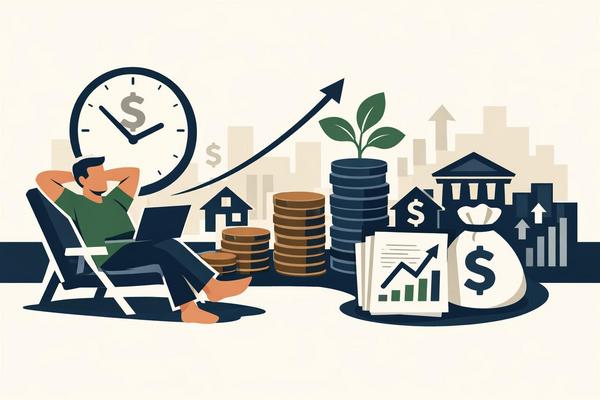
Your paycheck covers the basics, but you keep hearing that passive income is the way to finally get ahead.
Passive income is real, but most people hear the word passive and miss the part where somebody had to build the thing first. That’s where the confusion starts. You see social media clips about making money while you sleep, and it sounds like people found a secret shortcut. Usually they didn’t. Usually they spent years building savings, buying assets, learning a skill, or putting in a lot of unpaid setup work before the income got easier.
If you want a realistic answer to what passive income is, here it is: it’s income that doesn’t require your constant hour-by-hour labor to keep coming in. That does not mean no work. It means the work shifts. You either put in money up front, time up front, or both.
What Counts as Passive Income?
The cleanest way to think about passive income is that your income gets disconnected from your daily attendance. With a normal job, you show up, work your shift, and get paid. Stop showing up, and the money stops. With passive income, the money can keep coming in even when you’re not actively working that day. That’s the appeal.
Common examples include:
- Interest from savings, CDs, or bonds
- Dividends from stocks or funds
- Rental income from real estate
- Royalties from books, music, photos, or digital products
- Income from a business you own but don’t run day to day
- Affiliate or ad revenue from content you already created
Those are real income streams, but they’re not equally passive. A savings account is close to hands-off. A rental property is not. An online business might look passive from the outside while the owner is answering emails, updating pages, fixing problems, and handling taxes behind the scenes.
The Part People Always Leave Out
Most passive income starts as active income, active effort, or active risk. People often talk about the result and skip the build phase entirely. They tell you about the rent checks, not the down payment. They mention dividend income, not the decade it took to build a portfolio big enough to matter. They celebrate course sales, not the months spent writing, recording, editing, and finding an audience.
That doesn’t mean passive income is fake. It means you should judge it by the full timeline, not the highlight reel. There are basically three ways people create it: they invest a large amount of money they already have, they build an asset that can be sold repeatedly, or they buy something that throws off cash over time. Each path asks for something up front — if not cash, then time; if not time, then risk. Usually all three show up in some combination.
How Long Does It Actually Take?
The honest answer is longer than most people want to hear. Here’s a more grounded way to think about the timeline depending on where you’re starting from.
If You’re Starting With Money
Income from savings, bonds, or dividend funds can start right away because the asset already exists. The problem is scale. At today’s rates, even a decent yield on $10,000 isn’t going to replace your paycheck — it might cover part of your phone bill, a week of groceries, or a tank of gas. That’s still useful, but it’s not life-changing. For investment-based passive income to feel meaningful, you usually need a large amount of capital, many years of steady contributions, or both. That’s why a lot of “easy passive income” advice quietly assumes you already have money. If you don’t, the build takes longer.
If You’re Starting With Time
Maybe you don’t have a big pile of cash, so you try to create an asset instead — a blog, a YouTube channel, a digital download, a small app, stock photography, or a niche website. This route is more accessible, but the tradeoff is time and uncertainty. You might spend six months building something that earns almost nothing. You might spend two years before it becomes consistent. And even then, maintenance doesn’t disappear. Platforms change, traffic drops, competition shows up, and what looked passive can turn back into active work fast.
If You’re Buying a Cash-Flowing Asset
Rental property is the classic example. In theory, you buy the property, collect rent, and let the asset pay you. In real life, you deal with financing, repairs, vacancies, insurance, taxes, and the occasional 10 p.m. text about a leaking sink. You can hire a property manager, but that cuts into your margins. Real estate can absolutely produce passive income over time — it’s just rarely passive in the beginning, and for small landlords, it may never be fully passive.
Why It Feels Harder Right Now
A lot of Americans are trying to build passive income while living in an economy that makes the setup phase tougher. Housing costs are high. Groceries are expensive. Interest rates, credit card balances, and insurance bills eat into cash flow. A lot of people don’t have extra money to invest aggressively, which means they try to make up for it with side projects — building after work, tired, with limited time and no guarantee of payoff.
That’s one reason passive income advice often feels disconnected from real life. It treats everybody like they have spare capital, spare bandwidth, and a calm financial base. If you’re stretched thin, the smartest move may be to stabilize your finances first instead of forcing a passive income plan before you’re ready.
A More Useful Way to Think About It
Instead of asking how to make money while you sleep, ask what asset you can realistically build or buy from where you are right now. That question is less exciting, but a lot more helpful. It turns passive income from a fantasy into a planning problem.
Start by looking at your situation honestly. Do you have capital but not much free time? Do you have time but very little cash? Do you need extra income soon, or are you building for five years from now? How much uncertainty can you handle, and how much ongoing maintenance are you actually willing to deal with? If you have money, low-effort investment income may make sense even if it starts small. If you have more time than money, creating a digital asset or small business may be the better route. If you need cash immediately, a straightforward side job may be smarter than chasing something called passive that won’t pay off for a year.
There’s no shame in that. A lot of people would be better off earning active extra income, paying down high-interest debt, building an emergency fund, and then using that stronger base to create passive income later.
The Bottom Line
Passive income isn’t a magic stream that appears because you picked the right trick — it’s what happens when past work, past savings, or past risk starts paying you in the present. The passive part usually comes after a lot of active effort that people don’t talk about enough. Once you understand that, you can stop chasing shortcuts and start building something real.
If this made sense, the next thing worth understanding is the difference between cash flow and net worth — because they solve two very different money problems.