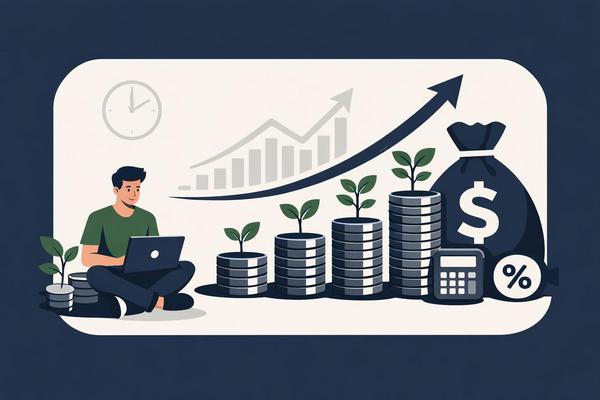
Your bills show up every month like clockwork, but your savings barely move unless you’re the one pushing every dollar in yourself.
That feeling is exactly why compound interest matters.
When you’re trying to build money in a world of rent, groceries, gas, and rising insurance costs, it can seem like the only way to get ahead is to earn more and save more — forever. Compound interest changes that math because it lets your money start pulling some of the weight.
This is one of the few personal finance ideas that actually deserves the attention it gets. Not because it’s flashy — because once you understand how it works, you stop seeing time as something you’re running out of and start seeing it as an asset.
What Compound Interest Actually Means
Simple interest pays you based only on the original amount you put in. Compound interest pays you on your original money and on the growth that money already produced. Your money earns money, and then that new money earns money too.
Let’s say you invest $1,000 and it grows by 10% in a year. Now you have $1,100. If it grows by another 10% the next year, you don’t just earn another $100 — you earn $110, because the growth is now happening on the bigger number. That extra $10 doesn’t sound like much. Give it enough years, though, and those little additions turn into the whole story.
Why the Early Years Matter More Than Most People Think
A lot of people assume the magic comes from investing huge amounts of money. That helps, obviously. But the real engine is time.
Picture two people. One starts investing at 25 and puts away $300 a month until age 35, then stops adding anything. The other waits until 35 and invests $300 a month every single month until 65. Even though the second person invests for three times as long, the first person can still end up with more money, depending on the return. The first person’s dollars got decades more time to compound — and that’s the part people miss.
Starting early isn’t just helpful. It’s often more powerful than contributing more later. Someone who begins in their 20s doesn’t need perfect timing, stock-picking genius, or a giant paycheck to build real wealth. They just need consistency and enough time.
What Waiting Actually Costs You
Most people don’t delay investing because they’re lazy. They delay because life is expensive — rent, credit card debt, car repairs, helping family, just keeping the checking account from getting wiped out. That’s real life in America.
Still, the cost of waiting isn’t just the money you didn’t invest. It’s the years of compounding you can never get back. If you skip investing $200 this month, you didn’t just lose $200 of principal. You lost what that $200 could’ve turned into over 20 or 30 years.
You can make up for a lot of things later. You can switch jobs, cut expenses, refinance debt, or increase your income. Time doesn’t work like that. Once a year passes, it’s gone for good — and because compounding gets stronger the longer it runs, the years you lose early are often the most expensive ones to lose.
A Quick Example That Makes This Real
Say your investments grow at an average of 8% a year. If you invest $5,000 at age 25 and never add another dime, that money could grow to more than $100,000 by age 65. Wait until 35 to invest that same $5,000, and it might only grow to around $47,000 by 65. The difference isn’t because you picked a better fund — it’s because the first $5,000 had ten more years to do the work. That’s the whole lesson in one snapshot.
Why It Feels Slow at First
This is where people get discouraged. In the beginning, compounding looks boring. Your account goes up a little, maybe down a little, and the gains don’t look life-changing. It can feel like watching water boil.
Early on, most of the growth comes from what you contribute, not from compounding itself. Then, after enough time passes, the balance gets big enough that the growth starts looking different. Your money begins producing larger dollar gains without you doing much besides staying invested. That’s when people suddenly call it powerful — but it was powerful the whole time. You just couldn’t see it yet.
It’s a lot like planting a tree. For a while, it doesn’t look impressive. Then one day it’s providing shade, and that only happened because someone planted it early and left it alone.
How to Put This to Work in Real Life
You don’t need a perfect plan to benefit from compound interest. You need a simple system you can stick with. The best move is usually to start with an amount that feels almost too small to matter, then keep going.
Here are the habits that make compounding real instead of theoretical:
- Start now, even if it’s a small monthly amount.
- Automate contributions so you don’t have to make the decision every month.
- Leave the money invested long enough for growth to build on itself.
- Increase your contributions when your income goes up.
- Avoid pulling money out unless it’s truly necessary.
If your job offers a 401k, that’s one of the most common places where compounding shows up in everyday life. If you’re using an IRA or a regular brokerage account, the same principle applies. The account type matters less than the behavior. Money needs time in the market, not constant interruption.
If You’re Starting Late, It Still Counts
Some people hear all this and think, great, I should’ve started at 22, so now I’m behind forever. That’s not a useful takeaway. Starting early is best, but starting late is still much better than never starting at all.
If you’re 35, 45, or even 55, compound interest can still work for you. You just have fewer years, which means consistency matters even more. The worst response to missing early compounding is deciding to miss the next ten years too. Stop losing more time — that’s the whole job at that point.
The Idea Worth Keeping
Most money advice focuses on effort — earn more, cut back, budget better. Those things matter. But compound interest rewards you for getting started and staying put. It’s the rare financial concept where time literally does the work for you, if you give it enough of a head start.
Start with what you can. Let time do what time does.
If this clicked, the next thing worth understanding is how inflation quietly eats into what your investment returns are actually worth.