Your grocery bill is higher, your rent went up, and the money sitting in savings doesn’t stretch like it used to.
You probably put cash in a savings account for a good reason. It feels responsible, steady, and safe.
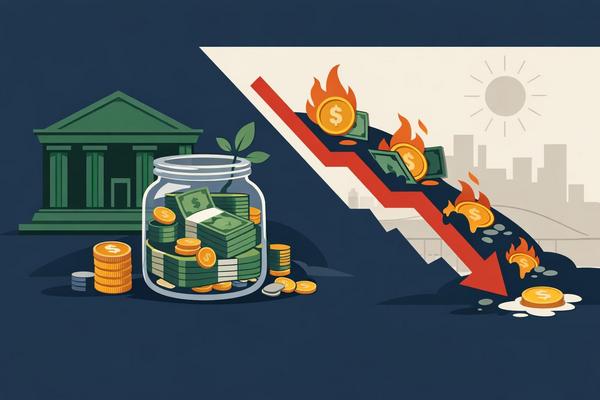
The problem is that “safe” only describes the account balance — not what that money can actually buy later. If your balance stays the same while prices keep rising, you’re losing ground even though the number on the screen hasn’t dropped. That’s the part a lot of people miss.
When people say they don’t want to invest because it’s risky, what they usually mean is they don’t want to see their balance go down. That’s understandable. Watching the market bounce around is uncomfortable. Still, avoiding investing altogether creates a different kind of risk — one that works quietly in the background every single year.
Why Your Savings Account Can Still Lose You Money
A savings account protects your cash from market swings. It gives you liquidity, stability, and FDIC insurance within limits. Those are real benefits.
What it usually doesn’t do is grow fast enough to keep up with inflation over long stretches of time. Inflation means the price of everyday stuff goes up. Groceries cost more. Gas costs more. Insurance premiums climb. Even when inflation cools down from a spike, prices don’t go back to where they were — they just rise more slowly.
Say you have $10,000 in a savings account earning 1%. If inflation is running at 3%, your money isn’t really growing. In purchasing-power terms, it’s falling behind by about 2% a year. That doesn’t feel dramatic in a single month, but over five or ten years it adds up. You still see $10,100, then $10,201, and it looks like progress — but if the cost of living rose faster than that, your money buys less than before.
Doing Nothing Is Still a Money Decision
A lot of people treat not investing like it’s a neutral choice. It isn’t. It’s still a decision about where your money lives and what happens to it over time.
If your money sits in cash for years, inflation is effectively charging you for standing still.
That’s why the real comparison isn’t just “investing is risky, savings is safe.” It’s this:
- Cash protects you from short-term market drops
- Investing gives you a better shot at outrunning inflation over the long run
- Holding too much cash for too long almost guarantees lost purchasing power
This matters because most financial goals are long-term goals. Retirement isn’t next month. Your kid’s college bill probably isn’t due tomorrow. Even if you’re saving for a home down payment, that timeline might be three, five, or seven years out. Leaving all of that money in low-yield cash can feel cautious, but it can also make the finish line harder to reach.
What Inflation Actually Takes From You
Inflation doesn’t usually wipe you out overnight. It’s more like a slow leak — you notice it in real life before you notice it in a spreadsheet.
Maybe your weekly grocery run used to be $120 and now it’s $160. Maybe your landlord raised rent another $150. Maybe your car insurance jumped for no obvious reason. Those increases are exactly why cash that earns very little becomes a problem over time. The account statement says one thing. Your actual life says another.
This is also why retirees and people on fixed incomes pay close attention to inflation. Rising prices hit harder when your income doesn’t move. The same principle applies to anyone building savings — if your money doesn’t grow, your future expenses don’t care. They keep moving up anyway.
Where a Savings Account Still Makes Sense
None of this means savings accounts are bad. They have an important job. Cash is for stability and access, not for doing all the heavy lifting of long-term wealth building.
A savings account makes sense for your emergency fund, monthly bills, money you’ll need within the next year or two, and anything you can’t afford to have fluctuating in value. Short-term money belongs somewhere stable. Long-term money usually needs a chance to grow. People run into trouble when they use the same parking spot for both.
If You’re Trying to Play It Safe in Real Life
If you’ve been keeping too much money in cash, you don’t need to swing to the opposite extreme. You don’t need to become a day trader or guess what the market will do next month.
The practical move is to separate your money by time horizon. Ask yourself three simple questions: What do I need available right now? What will I need within the next few years? What’s for goals that are far down the road?
Your emergency fund and near-term expenses can stay in cash — that part is about safety. Money for retirement or a 401k is different. That money has time to ride through market ups and downs, which is exactly why most people invest it instead of letting inflation chip away at it year after year. If you’re nervous, start with the principle: money you won’t need for a long time should usually be positioned to outgrow inflation. Otherwise, you’re asking cash to do a job it was never designed to do.
The Hidden Cost of Waiting for the “Right Time”
A lot of people know inflation is a problem but still wait. They tell themselves they’ll invest after the economy looks clearer, after rates change, after the election, or after the market calms down. That feeling is completely normal.
What waiting usually means in practice is giving inflation more time to reduce your buying power. Nobody gets a perfect entry point handed to them, and meanwhile the cost of living keeps moving. Doing nothing can feel careful because it’s quiet — but quiet doesn’t mean harmless.
That’s really the whole issue with savings account risk. The risk isn’t that your bank balance suddenly crashes. The risk is that your money slowly loses usefulness while you think it’s being protected.
The Bottom Line
Keeping some money in savings is smart. Keeping all your long-term money there can be expensive in a way that’s easy to miss — because playing it safe isn’t actually safe when inflation guarantees that standing still costs you something.
If this made sense, the next thing worth understanding is how interest rates affect the gap between what savings accounts pay and what inflation takes.