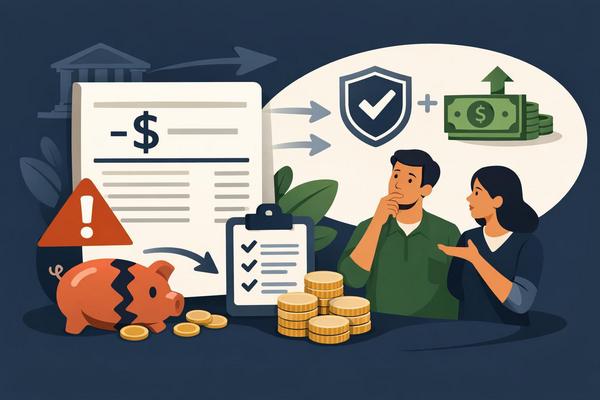
Your card got declined or your account went negative over a small purchase, and now the bank wants another $35.
Overdraft fees feel random when they hit, but they almost always come from a predictable gap between when money leaves your account and when money actually lands. If you’ve ever bought groceries, filled up your tank, or had an autopay bill hit a day too early, you already know how this goes. One small timing issue turns into a fee that costs more than the thing you bought.
These fees don’t hit everyone equally, either. They tend to land on people living close to the edge, where one late paycheck or one surprise charge can throw off the whole week. That’s what makes overdraft fees more than just annoying — they’re one of the most avoidable costs in banking, and they hit hardest when money is already tight.
What an Overdraft Fee Actually Is
An overdraft happens when your bank lets a transaction go through even though you don’t have enough money in checking to cover it. Then the bank charges you a fee for covering the difference — usually somewhere around $25 to $35, though it varies by bank.
Say you have $18 in your account and a $22 streaming bill hits. Your bank may approve the charge anyway. Now you’re negative $4, and a $35 overdraft fee gets stacked on top. Being short by a few dollars just cost you far more than the original purchase.
Some banks also charge NSF fees — non-sufficient funds. That’s slightly different. Instead of covering the transaction, the bank rejects it and still may charge you a fee. Either way, you’re paying because your balance and your transactions didn’t line up.
Why Overdrafts Happen More Than People Expect
A lot of people assume overdrafts come from reckless spending. Sometimes they do. More often, they come from timing, automation, and confusion about what’s actually available in your account. Your balance might look fine in the app, but that doesn’t mean every pending charge has posted. A restaurant tip can adjust later. A gas station can place a temporary hold larger than what you pumped. An automatic payment can hit overnight before your paycheck clears.
That gap has gotten wider because so much of modern banking runs on autopilot. Rent, utilities, subscriptions, insurance, debt payments — all coming out automatically. That helps you avoid late fees, but it also means your account can get hit from multiple directions before you even notice.
The Biggest Traps Are Boring, Not Dramatic
Usually it’s not some big shopping spree. It’s regular life.
- A paycheck arrives later than expected
- An annual subscription renews and you forgot about it
- A debit card purchase settles for more than the pending amount
- An autopay drafts the day before you thought it would
- You transfer money from savings just a little too late
Those are normal situations. They’re also exactly how banks collect fee revenue from people who were only off by a little.
How Banks Handle Overdrafts Behind the Scenes
Banks don’t all handle overdrafts the same way, which is part of the problem. Some let transactions go through and charge a fee. Some decline certain transactions. Some offer a small cushion before fees kick in. Some link your checking to savings for backup transfers. There are also rules around debit card and ATM overdraft coverage — in many cases, a bank needs your permission to let everyday debit purchases overdraft your account. Checks, ACH withdrawals, and recurring debit payments are a different story. If you don’t know what your bank does with each type of transaction, you’re basically guessing with your checking account.
The other thing that trips people up: your current balance and your available balance aren’t always the same number. Current balance is what the account holds right now. Available balance is what the bank says you can actually spend after pending transactions and holds. If you only look at the bigger number, you can get burned.
When Pending Charges Fool You
You buy lunch for $14 and see it pending. Later, another payment posts before that lunch charge settles — or a merchant placed a larger hold than the final amount. Gas stations, hotels, and restaurants do this all the time. Your balance looks safer than it really is for a day or two, and then the fees show up all at once. Avoiding overdrafts isn’t just about spending less. It’s about building a system that accounts for timing.
How to Stop Overdraft Fees Completely
The simplest way to stop overdraft fees is to make sure your account can never spend money you haven’t set aside. In practice, that means changing a few habits and account settings.
Turn off overdraft coverage. If your bank lets you opt out of overdraft coverage for ATM and everyday debit transactions, do it. A declined card is frustrating. A declined card plus a $35 fee is worse.
Keep a small buffer you treat as untouchable. Even $50 to $100 can absorb a timing mistake. This isn’t emergency savings — it’s a checking account shock absorber. Don’t think of it as money available to spend. Think of it as the amount that keeps your account from getting expensive.
Set low-balance alerts before things get critical. Pick a number that gives you time to react, not a number that’s already a crisis. If your account regularly drops near $200 before payday, set the alert at $250 or $300.
Put autopay bills on a calendar anyway. Autopay doesn’t mean forget about it. Keep a simple list of what comes out and when — rent, phone, internet, credit card minimums, insurance, streaming. Most overdraft fees can be avoided just by knowing which bills are about to hit before the bank tells you after the fact.
Separate spending money from bill money. If your paycheck lands in one account and everything comes out of the same pot, it gets messy fast. Even without opening multiple accounts, you can mentally split your balance — figure out what’s already spoken for and what’s actually safe to spend. A lot of people use one account for bills and another for day-to-day spending, and it makes a real difference.
Always check available balance, not just posted balance. When money is tight, this matters. Available balance gives you the better real-time picture because it accounts for pending charges and holds. It’s not perfect, but it’s more useful than the bigger number that makes you feel safe for no reason.
If It Keeps Happening, It’s a System Problem
If overdraft fees keep showing up, don’t make it a moral issue. You’re not failing some character test. Usually it means your checking account setup doesn’t match the reality of your cash flow — maybe your income is irregular, maybe your bills are stacked at the wrong time of month, maybe your buffer is too thin because every dollar already has a job.
Repeated overdraft fees are a sign your banking system needs to be redesigned around your actual life. That might mean changing due dates on a few bills, cutting a subscription or two, pausing autopay on nonessential charges, or switching to a bank or credit union with fewer fees and better alerts. Small changes can stop a cycle that quietly drains a lot of money over the course of a year.
The Bottom Line
Overdraft fees aren’t some unavoidable cost of being bad with money. They’re usually the price of bad timing, weak account settings, and a banking system that profits when you’re a few dollars short. Keep a buffer, know your bill dates, use alerts, and don’t let your bank turn small mistakes into expensive ones.
If this made sense, the next thing worth understanding is how credit card interest compounds when you’re carrying a balance month to month.