Your balances are spread across a few cards, the minimums eat your paycheck, and no matter how hard you try, making real progress feels impossible.
You already know how debt should work on paper.
If you throw extra money at the highest interest rate first, you usually pay less over time. That part is math.
The problem is that personal finance isn’t just math, because you’re the one who has to keep doing it month after month.
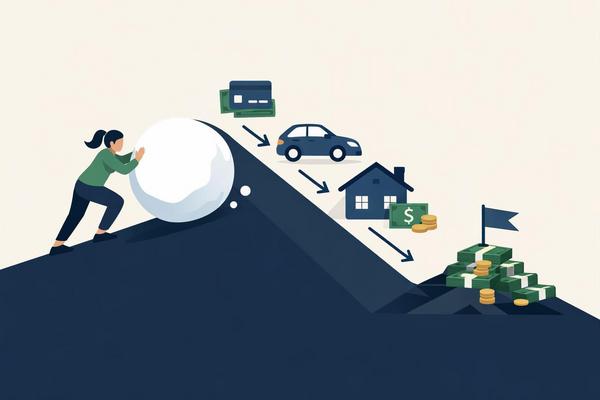
That’s why the debt snowball method keeps coming up. It tells you to pay minimums on everything, then put every extra dollar toward your smallest balance first. Once that one’s gone, you roll that payment into the next-smallest debt, and then the next one after that. The payment keeps getting bigger as each balance disappears — kind of like a snowball rolling downhill.
If you’ve ever looked at that strategy and thought, “Wait, isn’t that more expensive than paying the highest APR first?” — you’re not wrong. In a lot of cases, it is. Still, plenty of people succeed with it anyway, and there’s a real reason for that. It has less to do with spreadsheets than with behavior.
How the Debt Snowball Actually Works
Let’s say you have three debts:
- $500 medical bill
- $2,000 credit card
- $9,000 car loan
You keep making the minimum payment on all three. Then you aim every extra dollar at the $500 bill until it’s wiped out. After that, you take the money you were sending to that bill and add it to the minimum payment on the $2,000 card. Once the card is gone, you roll that whole amount into the car loan.
Each paid-off debt frees up cash flow, and that freed-up cash becomes fuel for the next one.
Compare that with the debt avalanche method, which targets the highest interest rate first. The avalanche usually saves more money. The snowball usually gives you a win faster. And for a lot of people, that difference matters more than finance nerds like to admit.
Why Motivation Matters More Than Perfect Math
Debt payoff isn’t a one-time decision. It’s a long string of boring decisions made while life keeps happening — your tire blows out, your kid needs new shoes, the electric bill spikes in July. You get tired, discouraged, or embarrassed and want to stop looking at your accounts altogether.
That’s where the snowball method earns its reputation. Small wins change your emotional relationship with debt. When one balance disappears, you’re not just saving a few bucks. You’re proving to yourself that this mess can actually shrink.
That matters because debt often feels endless. If your highest-interest balance is also one of your biggest balances, you could spend months attacking it without seeing a single account disappear. Mathematically, you’re making progress. Psychologically, it can feel like you’re running on a treadmill.
The snowball method shortens the distance between effort and reward. You put money in, then you see a result sooner. It’s the same reason people stick with habits when the payoff shows up quickly — checking off one debt gives your brain a clear signal that the plan is working.
What’s Going On Psychologically
There are a few real behavioral reasons people stick with the debt snowball.
Quick Wins Cut Through the Overwhelm
Debt stress isn’t just about the total amount you owe. It’s also about the number of bills, due dates, logins, and balances hanging over your head. Knocking out even one account can make your financial life feel less crowded. Less clutter creates relief, and relief makes it easier to keep going.
Visible Progress Keeps You in the Game
People don’t stay motivated by abstract future savings. They stay motivated by seeing movement. A zero balance is visible and concrete — you can point to it and say, “That one’s done.” Saving $18.43 in future interest this month doesn’t hit the same way.
When Your Identity Starts to Shift
Once you’ve paid off one debt, then another, you stop feeling like someone who’s drowning and start feeling like someone who pays things off. That shift is bigger than it sounds. People tend to keep doing things that match the story they now believe about themselves. If the story becomes, “I’m finally getting control of this,” the odds of sticking with the plan go up.
When the Snowball Makes the Most Sense
The snowball isn’t automatically the best choice for everybody. If you’re highly disciplined, love optimization, and won’t get discouraged by slow visible progress, the avalanche method may fit you better — you’ll likely save more on interest.
Still, the snowball tends to work especially well if you’ve started and stopped debt payoff before, you feel overwhelmed juggling multiple balances, you need early wins to stay consistent, or you’re trying to change habits rather than just run calculations.
If consistency is your weak spot, the method that keeps you consistent is usually the better method. That’s the part people miss when they argue about this online. The cheapest plan only works if you actually follow it.
A Practical Way to Use It in Real Life
You don’t need a complicated system. You need a plan simple enough to keep using when you’re busy or stressed.
Start by listing every debt with two numbers next to it: total balance and minimum payment. Order them from smallest balance to largest. Then pick one extra payment amount you can live with, even if it’s modest — maybe $50 a month from eating out less, picking up a side gig, or trimming a few subscriptions. Automate the minimums and manually send the extra to the smallest balance.
Track your balances somewhere visible. Use a notes app, a spreadsheet, or a piece of paper on the fridge if that’s what you’ll actually look at. Crossing out a paid-off debt sounds basic, but basic is fine. You want your progress to feel real.
And when a surprise expense hits — because it will — don’t let it kill the plan. Slow down for a month if you have to, then restart. People usually get out of debt by staying in the game, not by executing a flawless plan.
The Tradeoff Is Real, and That’s Okay
The debt snowball method is not the mathematically cheapest way to pay off debt in many cases. You may pay more in interest than you would with the avalanche approach. That’s a real tradeoff, not a myth.
But behavior has a price too. If the avalanche method saves you money in theory but you quit halfway through, the math advantage never shows up in real life. Momentum isn’t a soft concept or a silly emotional bonus — for a lot of people, it’s the whole engine.
The snowball turns a discouraging, slow-moving problem into a series of wins you can actually feel. And when you can feel progress, you’re much more likely to keep going until the debt is gone.
If this clicked, the next thing worth understanding is how minimum payments are designed to keep you in debt far longer than most people realize.