Your score dropped after one late payment or a maxed-out card, and now you’re wondering what actually matters.
Your credit score can feel weirdly personal. You pay your bills, try not to overdo it, and then some number moves up or down with no clear explanation.
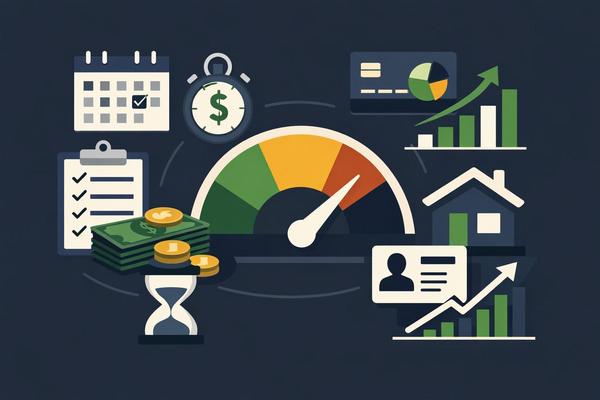
Most people spend time worrying about the wrong pieces of the formula. FICO scores are built from five main factors, but they don’t all carry the same weight. If you understand how payment history, credit utilization, and age of credit actually affect your score, you can stop guessing and start making moves that help.
The Five FICO Factors, in Plain English
FICO doesn’t treat every part of your credit life equally. Some behaviors send a loud signal. Others barely move the needle.
- Payment history — 35%: Whether you pay your bills on time
- Amounts owed / credit utilization — 30%: How much of your available credit you’re using
- Length of credit history — 15%: How long your accounts have been open
- New credit — 10%: Recent applications and newly opened accounts
- Credit mix — 10%: The types of accounts you have, like credit cards, auto loans, or a mortgage
Payment history and utilization make up most of the score. That matters because a lot of people obsess over things like having the “perfect” mix of accounts while carrying high balances or missing due dates. That’s backwards.
Why Payment History Matters More Than Almost Anything Else
Payment history is the biggest chunk of your FICO score because lenders care most about one question: do you pay what you owe? That’s why a single missed payment — especially if it goes 30 days past due and gets reported — can do real damage. The impact is often worse when you started with a strong score, because there was more room to fall.
From a lender’s point of view, this makes sense. A long record of on-time payments makes you look predictable. Start missing bills and you look riskier. It doesn’t matter if the missed payment happened because of a job loss, a medical bill, or simple forgetfulness. The scoring model just sees the missed payment.
When Money’s Tight, This Is the Priority
When cash is short, people often make a reasonable but costly mistake — they try to spread payments around and keep every account a little bit current. What usually matters more for your score is avoiding reported late payments.
In real life, that can mean setting autopay for at least the minimum payment, moving due dates so they line up with your paycheck, calling a lender before you miss a payment instead of after, or using reminders if autopay makes you nervous. That’s not flashy advice. It’s just the part that works.
Credit Utilization: The Factor People Notice Too Late
You can pay every bill on time and still hurt your score if your card balances are high. Credit utilization is basically the share of your available revolving credit you’re using, and it has a huge effect on your score.
Say you have one credit card with a $5,000 limit. If your balance is $500, your utilization is 10%. If your balance is $4,000, your utilization is 80%. Even if you pay on time both months, the second situation looks riskier. Scoring models tend to see high utilization as a sign that you may be stretched — which is why scores can drop when balances climb, even if you never miss a due date.
The Part Most People Get Wrong
A lot of people think carrying a balance helps their credit score. It doesn’t. You don’t need to pay interest to build credit, and you don’t need to carry debt month to month to look responsible. What helps is showing low usage relative to your limits and paying on time.
Timing matters too. Your credit card company usually reports your balance around the statement closing date, not the day you pay the bill. So if you run up a big balance and then pay it off after the statement closes, your score can still reflect high utilization for that month. If you’re planning to apply for a loan or an apartment, paying balances down before the statement date can help more than waiting until the due date.
Does Closing an Old Card Actually Wreck Your Score?
This is where people get overly cautious. They hear that old accounts help credit — which is true — and then start treating every account decision like it could wreck their score forever. Length of credit history only makes up about 15% of the score, so the reaction is usually bigger than the actual risk.
FICO looks at things like the age of your oldest account, the average age of all your accounts, and how long it’s been since you used certain accounts. A longer history gives lenders more data, but it’s still a supporting factor — not the main event.
Sometimes you should keep an old card open, especially if it has no annual fee and helps your available credit. Other times, closing it is fine. If the card has a fee or lousy terms, the decision shouldn’t be ruled entirely by credit score fear. The bigger risk from closing a card is usually the utilization hit — your total available credit shrinks, which can push your utilization ratio higher overnight. That’s the more immediate issue in most cases.
The Small Factors Get Too Much Attention
New credit and credit mix matter, but they’re supporting actors. Most people don’t need to open extra accounts just to “improve their mix,” and they don’t need to panic over every hard inquiry. One inquiry from applying for a credit card or loan usually has a limited effect. Opening several new accounts in a short span can matter more, because it lowers your average account age and may signal higher risk. Still, if your payment history is clean and your utilization is low, those two bigger factors do most of the heavy lifting.
How to Use This in Real Life
If your goal is a better FICO score, work the factors in order of impact — not the ones people talk about most online.
- Never miss a payment if you can help it
- Get credit card balances down, especially before applying for new credit
- Keep older accounts open when they still make sense
- Apply for new credit only when you actually need it
- Don’t open accounts just to chase an ideal credit mix
If you’re starting from scratch, the playbook is even more basic: open one manageable account, use it lightly, pay it on time, and let time do its job. If you’re rebuilding after mistakes, focus first on getting current and lowering balances. The score usually improves when the habits improve.
Most people focus on the minor factors when payment history and utilization are doing most of the damage — or most of the help.
If this clicked, the next thing worth understanding is how credit card interest works once you start carrying a balance.