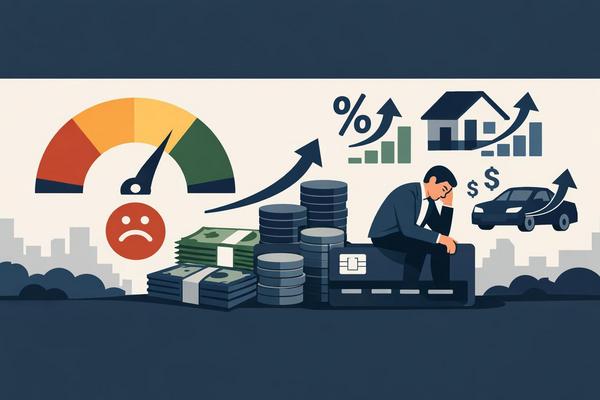
Your card rate is sky-high, your car payment feels ridiculous, and every lender quotes you numbers that seem way worse than what everyone else is getting. That’s not bad luck — that’s your credit score doing damage you might not even see.
A low credit score doesn’t just hurt your pride. It quietly raises the price of everyday borrowing, month after month.
Most people think of a bad score as a label. In real life, it’s a pricing system. Lenders use your score to decide how risky you look, and when you look risky, they charge you more. That extra cost shows up on credit cards, auto loans, personal loans, and sometimes even your insurance bill or apartment application.
Bad credit score costs feel less like a one-time penalty and more like a monthly tax on your financial life.
Why a Low Score Makes Everything More Expensive
A credit score is basically shorthand for one question: what’s the chance you won’t pay this money back on time? Lenders don’t know you personally. They don’t know you changed jobs, got hit with a medical bill, or missed payments during a rough stretch. They see a number, a report, and a pattern. If that number is low, they protect themselves the easiest way they can — by charging a higher interest rate.
Interest is the price of borrowing money. When your score drops, that price goes up. On paper, it may look like a few percentage points. In your budget, it can mean an extra $40, $120, or $300 a month depending on the loan. The lower your score, the more of your payment goes to interest instead of actually getting you ahead.
How Higher Rates Hit Your Monthly Payment Right Now
This is the part that sneaks up on people. A higher interest rate doesn’t just mean you pay more over time — it often means the monthly payment itself is higher starting today.
Take a car loan. If someone with strong credit gets a 6% rate and you get 13% on the same amount for the same term, your payment isn’t just a little higher. It can be meaningfully higher every single month. That’s money you could’ve used for groceries, gas, or child care.
The same thing happens with personal loans. A borrower with a solid score may qualify for a rate that keeps the payment manageable. A borrower with poor credit may get quoted a rate so high that the loan becomes expensive even if the amount borrowed isn’t that large. Credit cards are even worse because the balance can stick around. If your APR is well above average, carrying a balance becomes brutally expensive — you make a payment, a big chunk goes to interest, and progress feels painfully slow.
That’s the trap: low credit doesn’t just make borrowing harder, it makes getting out of debt slower too.
What This Looks Like in Normal Life
Two people finance the same used car. One has good credit and gets a decent rate. The other has a low score and gets a much higher one. They drive the same car to work. They buy the same gas. One just pays more each month because of a number tied to past credit behavior.
Now stretch that across multiple bills — higher credit card APRs, a more expensive auto loan, pricier personal loan offers, bigger deposits for utilities or apartments, and less flexibility when you need to refinance. Each one may not look devastating by itself. Together, they grind down your cash flow. The real cost of bad credit is usually hidden in your monthly bills, not in one dramatic fee.
It Reaches Beyond Loans
A lot of people think credit only matters when you’re applying for a card or a mortgage. Not really. Landlords may check it when you apply for an apartment. Utility companies may ask for a deposit. Insurance companies in many states use credit-based scores that can affect your premium. Even when you’re not borrowing money, a weak credit profile can still cost you.
That matters because plenty of people with low scores aren’t irresponsible. They’re just trying to get through expensive years, recover from a job loss, or clean up old mistakes. The system still prices them as higher risk. That’s what makes a low score feel like a tax — you keep paying more even after the original problem is behind you.
If Your Score Is Low, Here’s How to Use That Information
The point isn’t to feel bad about your score. The point is to understand where the money leak is. Once you see that bad credit score costs are baked into your monthly payments, you can start making smarter moves.
Focus on the Fixes That Actually Move the Number
Not every credit action matters equally. The biggest wins usually come from a few basics done consistently: pay every bill on time even if it’s just the minimum, bring down credit card balances if your utilization is high, avoid applying for a bunch of new accounts at once, check your credit reports for errors and dispute anything inaccurate, and keep older accounts open when it makes sense since credit history length matters.
None of that is flashy. It works because credit scores respond to patterns, not good intentions. Small improvements in your score can translate into cheaper money down the road.
Compare Offers Before You Lock In
If you need to borrow, don’t assume the first quote is the only quote. Different lenders price risk differently, and even with the same score, one lender might offer a noticeably better rate than another. A lower rate reduces both total interest and the monthly payment, which matters a lot when your credit is shaky. A stretched-out loan with a bad rate can feel affordable this month and still cost you thousands more overall.
Protect Your Cash Flow While You Rebuild
If your current debt is already expensive, your first goal may not be perfection — it may be breathing room. That means avoiding new high-interest debt when possible, staying current on existing accounts, and freeing up cash anywhere you can. A lower grocery bill, a trimmed subscription list, or a cheaper phone plan won’t fix your score by itself, but it can help you stop missing payments. That’s where real progress starts. If you can stabilize your cash flow, you give your credit a real chance to recover.
The Part Most People Miss
People often treat credit like a report card from the past. It is that, but it’s also a price tag on your future. A low score doesn’t stay trapped in your credit file — it follows you into the rate on your next card, the payment on your next car, and the options you have when life gets expensive. Improving your credit isn’t just about qualifying for something later. It’s about lowering the cost of being you in the financial system you already live in.
If this clicked, the next thing worth understanding is how credit card utilization can move your score faster than almost anything else you do.