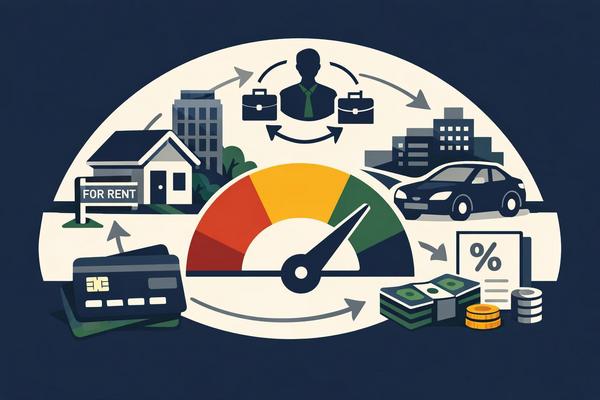
You apply for a car loan and the payment comes back higher than your friend’s — same car, same dealership, different number. You try to rent an apartment and the landlord wants a bigger deposit. You fill out job paperwork and spot a line about a credit check. That’s when your credit score stops feeling like some abstract finance thing.
What a Credit Score Actually Is
A credit score is a three-digit number — usually between 300 and 850 — that tells lenders how risky you look based on your borrowing history. The higher the number, the more likely you appear to pay back what you owe on time.
That number comes from your credit reports, which are maintained by the three major credit bureaus: Experian, Equifax, and TransUnion. Your credit report is the full file. Your credit score is the shortcut version of that file — think of it like the difference between your full transcript and your GPA.
Different companies use different scoring models, with FICO and VantageScore being the two you’ll hear most. That means you don’t have just one credit score — you have several versions, but they all try to answer the same basic question: how likely are you to handle debt responsibly?
How the Score Gets Calculated
Credit scores are built from patterns, not gut feelings. The models look at how you’ve used credit over time, and the same big factors show up across every major scoring system.
- Payment history: Do you pay your bills on time, or do you miss payments?
- Credit utilization: How much of your available credit are you actually using, especially on credit cards?
- Length of credit history: How long have your accounts been open?
- Credit mix: Do you only have credit cards, or have you handled different kinds of debt?
- New credit: Have you applied for a bunch of new accounts recently?
Payment history carries the most weight. Miss a payment by 30 days or more and it can do real damage. But here’s the part that trips a lot of people up: you can be making payments every single month and still look risky if your card balances are too high compared to your limits. That’s called credit utilization, and it matters more than most people realize.
Credit scores reward steady behavior over time — paying on time, keeping balances low, not constantly opening new accounts. That does more for your score than any shortcut you’ve seen online.
Why Lenders Price Everything Around It
When a bank or credit union lends you money, they’re making a calculated bet on whether they’ll get paid back. Your credit score helps them decide how much risk they’re taking on — and they charge you accordingly.
A strong score can mean lower interest rates and better terms. A weak score can mean a higher rate, a lower limit, or a flat-out denial. On a mortgage, even a small rate difference can add up to tens of thousands of dollars over the life of the loan. On a car loan, it shows up in your monthly payment every single month. Your score doesn’t just affect whether you get approved — it affects the price you pay to borrow. That’s why two people can buy the same car and walk out with very different payments. It’s not always about income. Sometimes it’s the score.
Why Your Score Can Affect Where You Live
Landlords and property managers often pull credit reports or scores when screening tenants. They want to know if you pay what you owe and whether you’re likely to pay rent on time.
A lower score doesn’t automatically disqualify you, but it can create extra hurdles — a larger security deposit, a co-signer requirement, proof of higher income, or in a competitive rental market, just losing the place to someone who looks less risky on paper. If you’ve ever lost an apartment and couldn’t figure out why, credit may have been part of the story.
Can It Really Affect Your Job?
Sometimes, yes. Not every employer checks credit, and the rules vary by state and by role. But for jobs involving money, security clearances, or access to sensitive financial information, some employers may review a modified version of your credit report. They’re not looking at the exact score a lender would see — they’re scanning for signs of serious financial distress, major delinquencies, or collections that raise red flags.
A rough credit history doesn’t make you unemployable. But your financial record can spill into parts of life that don’t seem connected to borrowing at all. Your credit score is essentially a reputation system for how you’ve handled debt — and reputation systems have a way of spreading.
If Your Score Needs Work, Start Here
Credit scores aren’t permanent labels. They’re snapshots based on ongoing behavior, which means they can improve. Focus on the basics that actually move the needle.
- Pay every bill on time, even if it’s just the minimum
- Keep credit card balances low relative to your limits
- Avoid applying for multiple new accounts in a short stretch
- Leave older accounts open when it makes sense
- Check your credit reports for errors and dispute anything that looks wrong
You don’t need to obsess over every point. You do need to understand the pattern. Late payments, high utilization, and a flurry of new applications make you look unstable. Consistency makes you look safer. If you’re carrying a lot of card debt, paying those balances down is one of the fastest ways to see your score move — not overnight, but noticeably.
The Real Reason This Number Matters
It’s easy to treat credit scores like some annoying game made up by banks. But the practical reason to understand yours is straightforward: it affects the cost and flexibility of your everyday life — what you pay for a car, whether you get approved for a mortgage, how easy it is to rent a place, and whether certain employers see red flags when they pull your file.
Once you see it that way, managing your credit stops being a finance nerd hobby and starts looking like basic life maintenance.
If this made sense, the next thing worth understanding is how credit card interest turns an ordinary balance into a long, expensive problem.