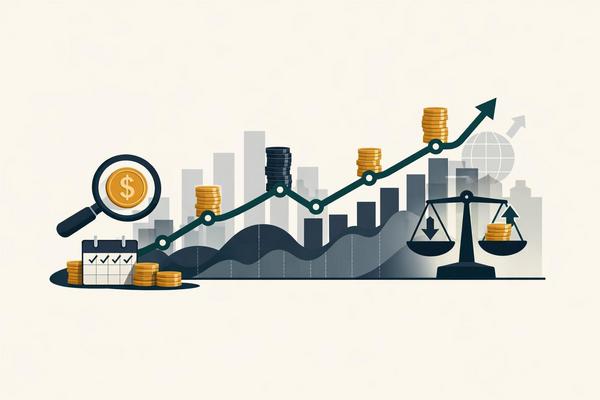
Your paycheck hits, the market looks shaky, and you freeze because you don’t want to buy at the wrong time.
That hesitation is exactly why dollar cost averaging makes sense for so many regular investors.
When people ask how dollar cost averaging works and whether it reduces investment risk, they’re usually asking something more personal: what do you do when you want to invest, but the timing always feels off?
Dollar cost averaging helps because it takes the timing pressure off your shoulders — and that’s a bigger advantage than most people realize.
What Dollar Cost Averaging Actually Is
Dollar cost averaging means you invest a set amount of money on a regular schedule, no matter what the market is doing. You might put $200 into an index fund every two weeks when you get paid, or $500 into your IRA every month.
The amount stays the same, but the number of shares you buy changes based on the price. When prices are higher, your money buys fewer shares. When prices are lower, it buys more.
Over time, that creates an average purchase price without requiring you to guess the market’s next move.
A Quick Example
Say you invest $300 a month into the same fund for four months.
- Month 1: share price is $30, so you buy 10 shares
- Month 2: share price drops to $20, so you buy 15 shares
- Month 3: share price rises to $25, so you buy 12 shares
- Month 4: share price is $15, so you buy 20 shares
You invested $1,200 total and bought 57 shares, with an average cost of about $21.05 per share. You didn’t need to know in advance which month would be best. You just kept buying.
Why Timing Feels Harder Than It Should
Most people don’t struggle with investing because they can’t do the math. They struggle because investing asks you to put money into something uncertain, and uncertainty messes with your head.
When the market is up, it feels like you’re buying at the top. When it’s down, it feels like you’re catching a falling knife. When rent, groceries, and gas are already eating your paycheck, a wrong move feels expensive.
The real problem isn’t just market volatility — it’s that waiting for the perfect moment usually turns into not investing at all. That’s the structural reason dollar cost averaging works better than people expect. It doesn’t magically improve the market. It improves your behavior inside the market.
Does It Actually Reduce Risk?
Yes, but not in every sense people mean when they say “risk.”
Dollar cost averaging can reduce the risk of investing a large lump sum right before a market drop. If you spread your purchases over time, you lower the odds that all your money goes in at one bad price. That’s real risk reduction — especially useful when you’re investing a windfall, rolling over an old 401k, or finally putting cash to work that’s been sitting on the sidelines.
What it really reduces is timing risk and emotional risk. It lowers timing risk because you’re not making one all-or-nothing bet on a single day. It lowers emotional risk because you don’t have to make a fresh decision every time the market gets scary.
That said, it does not eliminate market risk. If the investments you buy lose value over a long period, dollar cost averaging won’t shield you from that. If you buy a bad stock over and over, you’re still buying a bad stock. If the whole market falls, your account can still go down. That’s worth being clear about.
What It Doesn’t Do
- It doesn’t guarantee a profit
- It doesn’t prevent losses
- It doesn’t beat lump-sum investing every time
- It doesn’t fix poor investment choices
Historically, lump-sum investing often wins when markets trend upward, simply because more money is invested sooner. But if investing everything at once makes you panic, second-guess yourself, or sit in cash for six months, the textbook answer stops being very useful.
Why It Works in Real Life
Personal finance only works if you can actually stick with it. That’s where dollar cost averaging shines — it turns investing into a routine instead of a prediction game. You stop asking, “Is this the right week to buy?” and start saying, “This is what I do every payday.”
This is why 401k plans are such a powerful example of dollar cost averaging in action. Money comes out of each paycheck automatically. You buy through bull markets, recessions, election years, and inflation spikes — through all the headlines that make people nervous. Most workers aren’t watching charts all day. They’re just steadily buying while living their lives, and that simple system removes a lot of chances to sabotage yourself.
When It Makes the Most Sense
This approach tends to fit best when you invest from each paycheck, you’re new to investing and don’t fully trust your timing instincts yet, you have a lump sum but feel nervous putting it all in at once, or you want a process that keeps you moving during volatile markets. It may matter a little less if you already have a long time horizon, a high risk tolerance, and a clear plan for lump-sum investing — but for regular monthly contributions, dollar cost averaging is often just the natural result of how people earn money anyway.
How to Set It Up Without Overthinking It
You don’t need a complicated system. In fact, the more complicated you make it, the more likely you are to quit. A practical setup usually looks like this:
- Pick the account you want to fund — a 401k, IRA, or taxable brokerage account
- Choose a fixed dollar amount you can keep contributing without straining your budget
- Set an automatic schedule tied to payday or the same date every month
- Stick with broadly diversified investments rather than trying to trade in and out
- Keep going when the market is up, down, or just plain boring
The power comes from removing decisions, not adding more of them.
If your budget is tight, start smaller than you think you should. A modest amount invested consistently beats a bigger plan you never follow through on. If your income changes, adjust the contribution — but keep the habit alive. The habit is doing most of the heavy lifting here.
The Takeaway Most People Miss
People often judge dollar cost averaging as if its only job is to maximize returns on paper. That’s too narrow. Its real value is that it helps regular people participate in the market without having to outsmart it.
Missed time in the market can be more damaging than buying at an imperfect price. Dollar cost averaging removes the pressure of picking the right moment — which is exactly why it works better than most people expect.
If this made sense, the next thing worth understanding is how index funds spread your risk without turning investing into a full-time job.