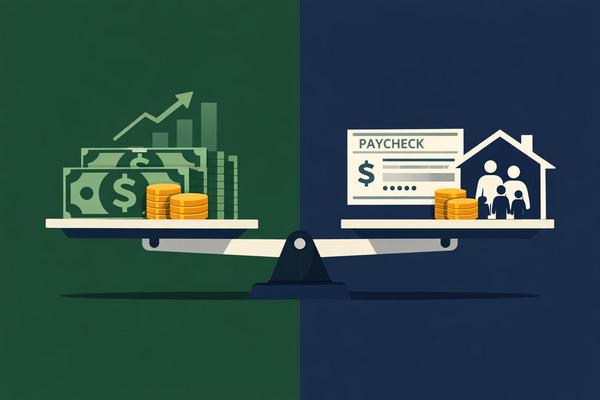
You get a raise, or you see a job offer with a bigger salary, and for a second it feels like real progress. Then payday hits, and the deposit is a lot smaller than the number you had in your head.
That gap is exactly why gross income vs net income matters in real life.
Gross income is what you earn before taxes and deductions come out. Net income — your take-home pay — is what you actually keep. And when you’re figuring out whether you can cover rent, buy groceries, save for retirement, or take on a car payment, take-home pay is the number that actually runs your life.
Your Salary Isn’t the Money You Can Spend
A lot of money confusion starts right here. People talk about salary like it’s fully available cash. If you make $60,000 a year, it sounds like you have $60,000 to work with. You don’t.
Before that money reaches you, several things get pulled out:
- Federal income tax
- State income tax, depending on where you live
- Social Security and Medicare taxes
- Health insurance premiums
- 401(k) or other retirement contributions
- HSA, FSA, or other workplace benefit deductions
So your gross income is your headline number, but your net income is your usable number. Say your gross pay for one biweekly paycheck is $2,300. After taxes, insurance, and retirement contributions, your actual deposit might be closer to $1,650. That’s the money you can use for rent, gas, food, your phone bill, and everything else. The rest may still benefit you — health coverage, retirement savings — but it’s not cash you can spend this month.
Why the Gap Feels Bigger Than You Expected
Part of it is psychological. You hear your annual salary first, and that number sticks. It becomes what you attach your expectations to. Then your actual paycheck lands and it feels like money disappeared — but it didn’t. It got divided before it ever got to you.
Some of that division is mandatory, like payroll taxes. Some depends on your choices, like how much you put into a 401(k). And some depends on where you live, because state income tax can make a real difference. Move from Texas to California and your gross salary might stay exactly the same while your take-home pay shrinks. Add family health insurance at work and your paycheck gets smaller even if your salary doesn’t budge.
This is why two people with the same gross income can have very different financial lives. One has high insurance costs, big retirement contributions, and state taxes. The other has lower deductions and keeps more of each check. On paper they earn the same. In practice, their monthly cash flow looks nothing alike.
When Each Number Actually Matters
Gross income isn’t useless. It matters for tax brackets, loan applications, salary comparisons, and understanding your total compensation. Employers quote gross pay because that’s what they agree to pay before deductions. Lenders often use gross income because it’s a standard benchmark.
But for your day-to-day decisions, net income is the better guide. You can’t pay rent with pre-tax dollars that never hit your checking account. You can’t decide whether a car payment is affordable based on salary alone. If the money never reaches your bank account, it shouldn’t be treated like spendable income.
A simple way to keep it straight: use gross income to understand your earning power, and use net income to run your actual life.
That Job Offer Looks Better — But Does It Pay Better?
This matters a lot when you’re comparing jobs. A higher salary doesn’t always mean a meaningfully bigger paycheck. Say you’re making $55,000 and get an offer for $62,000. That sounds like a clear win — but maybe the new job has pricier health insurance, no 401(k) match, a longer commute, and state taxes you don’t currently pay. Suddenly that raise doesn’t go nearly as far as you expected.
The smart move is to compare expected take-home pay and total costs, not just the salary number. That means looking at estimated taxes, health and dental premiums, retirement match, commuting costs, and cost of living if you’re relocating. Gross pay gets your attention. Net pay tells you whether the move actually improves your life.
Build Your Budget Around What Lands in Your Account
If you’re trying to get your finances under control, start here. Build your budget around what actually hits your account each month — not your salary, not hoped-for overtime, not a bonus that might show up later. Use your regular take-home pay. That keeps your plan grounded in reality and helps you spot financial stress before it becomes a crisis.
If your fixed bills eat up most of your net income, your budget is tight even if your gross salary sounds solid. That’s not you being bad with money. That’s just math.
Here’s a practical way to apply it:
- Check your actual average monthly take-home pay from the last 3 to 6 months
- List your fixed bills — rent, insurance, minimum debt payments, utilities
- Estimate flexible spending like groceries, gas, eating out, and household stuff
- See what’s left for saving, investing, and extra debt payoff
Once you start with net income, your financial decisions get more honest. You stop using inflated numbers. You stop assuming a raise solves everything. You stop committing to bills based on money you never actually receive.
The Number That Pays Your Life
Gross income matters and you should know it — but it’s not the number that pays your bills, fills your fridge, or builds your savings. Your take-home pay does all of that, and the gap between the two affects every financial decision you make.
If this clicked, the next thing worth understanding is how taxes and paycheck withholding change what you actually keep from every raise you get.