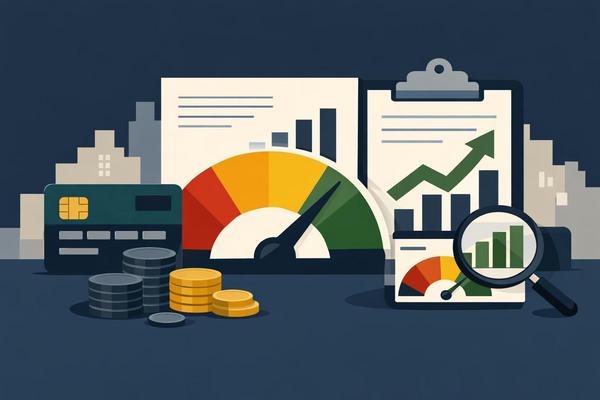
Your card balances look manageable, but your credit score keeps slipping anyway.
If your credit score dropped even though you paid on time, your credit utilization ratio may be the reason. That sounds technical, but the idea is simple — it’s just the percentage of your available credit you’re using right now. If you’ve got a $1,000 balance on a card with a $5,000 limit, your utilization on that card is 20%.
Credit scoring models care about this a lot. It makes up a big chunk of your score — nearly a third of it — and a lot of people hurt themselves without realizing it.
You can be doing what feels responsible in real life — using your card for groceries, gas, bills, and paying it off every month — and still get dinged. That’s because your score doesn’t only care whether you pay. It also cares what your balance looks like when the card issuer reports it.
Why Your Score Can Drop Even When You Pay on Time
This is the part that catches people off guard. Most credit cards report your balance to the credit bureaus once a month, usually tied to your statement closing date — not the day you make your payment.
Let’s say you put a big car repair on your card and your statement closes before you pay it off. The credit bureaus may see a high balance, even if you pay the full amount a few days later. To the scoring model, it can look like you’re leaning harder on credit than usual — even though you did nothing wrong. Your utilization rate is a snapshot, and sometimes that snapshot lands at the worst possible moment.
What Counts as a Good Credit Utilization Ratio?
There’s no single magic number written into the credit system, but there are some useful rules of thumb.
- Under 30% is generally considered acceptable
- Under 10% is usually better for your score
- At 0% across every card isn’t always ideal either
- Maxing out even one card can hurt, even if your total utilization looks fine
That last point matters more than people think. You might have three cards with a total limit of $15,000 and only use $3,000 overall — that’s 20% total utilization, which sounds decent. But if one of those cards has a $3,000 limit and it’s maxed out, that card can still drag your score down on its own.
Scoring models often look at both your overall utilization and your per-card utilization. Here’s a simple example of how that plays out.
- Card A: $500 balance on a $5,000 limit = 10%
- Card B: $2,000 balance on a $2,500 limit = 80%
- Total: $2,500 balance on $7,500 limit = 33%
In that example, both numbers are working against you. Your overall utilization is above the comfort zone, and one card is especially high. Even if you never miss a payment, that pattern can make your score look riskier than it actually is.
Why Lenders Pay Attention to This Number
Lenders want to know whether you’re stretched. A high utilization rate can signal that you’re relying on credit to get through the month. Maybe that’s true, maybe it isn’t — the scoring model doesn’t know your full story. It just reads the numbers.
If your balances are consistently high relative to your limits, the system may treat you as a bigger risk. That can affect more than your score. It can shape the rates you get on a car loan, a mortgage, or even a balance transfer offer. The good news is that utilization is also one of the easier parts of your score to manage. Unlike a late payment, it doesn’t leave a long scar. When your reported balances go down, your score can bounce back pretty quickly.
If You Put Everything on Your Card, Here’s How to Stay Ahead
A lot of people run most of their monthly spending through credit cards for convenience, rewards, or cash flow. That’s not automatically a problem. The trick is making sure the reported balance stays low enough.
- Pay your card before the statement closing date, not just by the due date
- Make multiple payments during the month if you spend heavily
- Keep each card below 30%, and preferably below 10% if you’re trying to boost your score
- Spread spending across more than one card instead of crowding a single limit
- Ask for a credit limit increase if your income and payment history support it
- Avoid closing old cards unless there’s a strong reason, since that shrinks your available credit
The easiest fix for a high utilization rate is often paying earlier — not necessarily paying more overall.
The “I Pay in Full Every Month” Trap
Say you charge $2,500 a month on a card with a $3,000 limit and pay it in full every month. From a personal finance standpoint, that’s perfectly disciplined. But if your issuer reports the balance before your payment posts, your utilization could show up around 83%. Your score may react to that reported balance, not your intention — which is why people sometimes see a drop and assume there’s a mistake. A lot of the time, it’s just utilization and reporting timing. You can be financially responsible and still look overextended on paper for a few weeks.
When Utilization Matters Most
Utilization matters all the time, but it matters even more when you’re about to apply for new credit. If you’re planning to finance a car, apply for an apartment, or shop for a mortgage, this is worth paying attention to a month or two ahead of time. That’s when you want your reported balances looking clean — not zero across the board necessarily, but low.
If money is tight and you can’t pay balances down quickly, focus on the cards with the highest utilization first. Bringing one card from 95% to 45% can help more than shaving a little off several low-balance cards. The goal is to stop looking maxed out.
The Part Most People Get Backwards
People tend to obsess over payment history and ignore utilization until their score moves the wrong way. Payment history is huge, of course, but utilization is one of the few major score factors you can actually influence fast. Keep balances low relative to your limits, watch your statement dates, and pay before the balance gets reported — not just before it’s due. That’s how you use credit cards every day without quietly damaging your score.
If this made sense, the next thing worth understanding is how closing a credit card can affect your credit score.