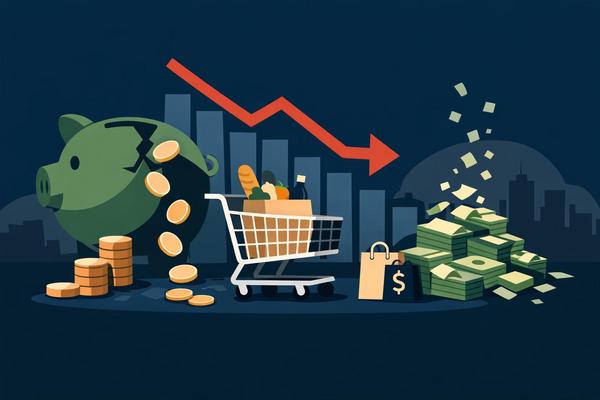
Your grocery bill is higher, your rent went up, and the cash sitting in your savings account doesn’t stretch like it used to — that’s not bad luck, that’s inflation doing its thing.
If you’ve been doing the responsible thing and keeping money in savings, it can feel confusing to hear you’re still losing ground. That happens because inflation doesn’t need to take money out of your account to make you poorer. Your balance might look the same, or it might creep up a little from interest, but what really matters is what that money can buy when you actually need it. When prices rise faster than your savings do, your dollars quietly lose buying power.
Your Balance Stayed Put. Prices Didn’t.
Most people look at savings in dollars, not in purchasing power. If you have $10,000 in a low-interest account this year and it’s still around $10,000 next year, it feels like nothing changed. But a “stable” balance can actually mean you’re falling behind.
Let’s say inflation runs at 4% and your savings account pays 1%. On paper, you earned something. In practice, the cost of groceries, insurance, gas, utilities, and basic services rose faster than your money did — so the same savings now buys less than it did before.
You don’t notice it all at once because inflation usually shows up in pieces. A few extra dollars at the grocery store. A rent increase when your lease renews. A car repair that costs more than you expected. A higher restaurant tab for the same meal you used to order without thinking twice. Those small increases add up, and your savings has to absorb the difference.
What Inflation Is Really Doing to Your Money
Inflation is just a broad rise in prices across the economy. When prices go up, each dollar buys a little less — that’s the core problem. This is why people say cash “loses value” over time. They’re not saying your bank deletes your money. They’re saying the real-world usefulness of that money shrinks.
Think of it this way: if $100 used to cover a week’s worth of groceries and now it covers five days, the money changed even if the number on the bill didn’t. The same logic applies to your savings account.
This matters even more when your savings rate is low. A lot of traditional savings accounts pay interest that’s nowhere near enough to keep up during higher-inflation periods. So even though you’re technically earning interest, you’re still losing buying power in net terms. That’s what people mean by “real return” — not just what you earned, but what you earned after inflation took its cut.
A Quick Real-World Example
Say you keep $5,000 in an account earning 0.5% interest. After a year, you’d have about $5,025. If inflation ran at 3.5% over that same stretch, the stuff you buy got more expensive much faster than your account grew. The number went up, but your financial position didn’t improve in the way that actually matters.
Why Emergency Savings Gets Hit Differently
Not every dollar you have needs to be working hard all the time. Some money is supposed to be safe, boring, and easy to access — that’s exactly what an emergency fund is for. The goal of emergency money isn’t to beat inflation every year. It’s to be there when your tire blows out, your hours get cut, or your dog ends up at the vet on a Saturday.
So this isn’t an argument for keeping zero cash. It’s an argument for understanding the tradeoff. Cash gives you safety and flexibility, but over time, inflation chips away at what that cash can do. The money you keep in low-interest savings should match a purpose. If it’s your emergency fund, that tradeoff makes sense. If it’s money you won’t touch for years, leaving all of it parked in a low-yield account may cost you more than you realize.
When “Playing It Safe” Starts Costing You
A lot of people leave extra cash in savings because it feels safer than making a wrong move. That’s understandable — market drops are scary, economic headlines are exhausting, and sometimes doing nothing feels better than taking a risk you don’t fully understand. Still, doing nothing is its own decision, and inflation is the price tag attached to it.
Here’s where people get tripped up: they think of risk only as losing money in an investment account. They don’t think about the risk of guaranteed purchasing power loss from idle cash. That risk is quieter, but it’s real — and over longer periods, it can do more damage than people expect.
You May Already Be Seeing It
You might not be calling it inflation risk, but you’ve probably felt it:
- Your emergency fund covers fewer months of expenses than it used to.
- The down payment you were saving for doesn’t go as far because home prices moved up.
- The vacation fund that once felt solid barely covers flights and hotels now.
- Money you set aside for a car replacement no longer matches what used cars actually cost.
The account may look healthy, but the goal attached to that money keeps getting more expensive.
How to Think About Savings Without Fooling Yourself
You don’t need a complicated system. You just need to separate money by job. Some cash should stay liquid and stable. Other money needs a better shot at keeping up with rising costs over time. A practical way to think about it:
- Keep short-term and emergency money somewhere safe and accessible.
- Pay attention to the interest rate on your savings — tiny differences matter more when inflation is high.
- Don’t assume a growing balance means growing purchasing power.
- Review old savings goals and update them for current prices, not last year’s prices.
- If money is for long-term goals, recognize that leaving all of it in a low-interest account may slowly weaken your position.
The point isn’t to chase returns on every dollar. It’s to be honest about what inflation is doing in the background while your money sits still.
The Bottom Line
If your savings account pays less than inflation, your money isn’t holding its value in any meaningful sense. It may still be the right place for emergency cash, and it may still help you sleep at night — but it isn’t neutral. Money sitting in a low-interest account doesn’t stay the same; inflation slowly shrinks what it can actually buy. Once you see savings through that lens, it gets a lot easier to decide what cash should stay parked and what cash needs a different job.
If this made sense, the next thing worth understanding is how interest rates affect what banks actually pay on savings accounts — and why that number moves around more than most people realize.