Your bills are covered on paper, but your money still disappears faster than it should — and when you sit down to budget, the part that should be simple turns into a fight with yourself.
Is takeout a want, or is it getting you through a week when work is chaos? Is your car payment a need if you have to drive to your job?
This is where most budgets break down: not because you can’t do math, but because real life doesn’t divide itself neatly into needs and wants. If you treat every choice like it’s obvious, your budget starts feeling fake. Then you ignore it, overspend, and assume budgeting just doesn’t work for you.
The fix isn’t being stricter. It’s getting clearer about what a need actually is, what a want actually is, and what to do with the spending that lives in the gray area.
Why the Line Gets Blurry Fast
A lot of personal finance advice makes this sound cleaner than it is. Housing is a need. Streaming is a want. Groceries are a need. Designer sneakers are a want. That part’s easy.
What throws people off is that most spending isn’t one clean category. Your phone bill may be a need because your boss, your kids’ school, your bank, and your doctor all expect you to be reachable. Your car may be a need if there’s no practical public transit where you live. Internet may be a need if you work remotely or manage your finances through apps and websites.
A need isn’t just something required for survival in theory — it’s something required for your actual life to function. That’s why two people can look at the same expense and classify it differently. A car in Manhattan might be a want. A car in a suburb with no bus line is probably a need. Day care can look optional from a distance, but for a working parent, it may be the thing that makes income possible in the first place.
A Better Way to Define Needs and Wants
If you want a budget that holds up in real life, use a practical test instead of a moral one. Don’t ask, “Should I spend this?” Ask, “What happens if I cut this?” That question gets you closer to the truth.
Needs Keep Your Life Stable
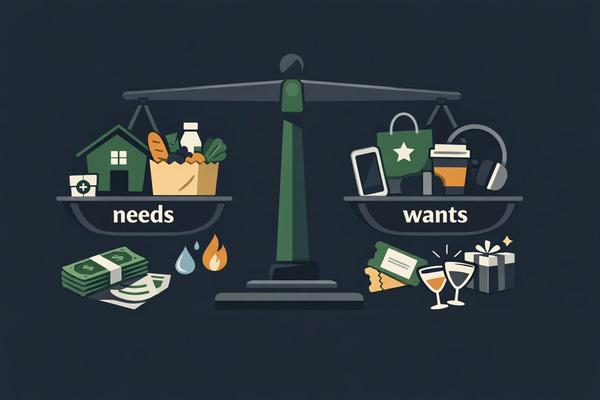
A need is spending that protects your basic safety, income, health, or ability to function day to day. That usually includes rent or mortgage, basic utilities, groceries, transportation to work or school, insurance, minimum debt payments, child care that allows you to work, basic phone and internet service, and essential medical expenses. If removing the expense would put your housing, job, health, or financial stability at risk, it’s a need.
Wants Make Life Better — But They’re Still Optional
A want is something that improves your quality of life but isn’t required to keep things running. That doesn’t make it stupid or wrong. It just means it’s a choice. Common wants include dining out, entertainment subscriptions, vacations, hobbies, impulse purchases, and clothes beyond what’s practical.
Notice that “upgraded versions” matters here. You may need a phone — you probably don’t need the newest top-tier model with the biggest data plan. You may need a place to live — you may not need the pricier apartment with the rooftop lounge. In a lot of budgets, the real issue isn’t a pure want; it’s turning a need into a premium lifestyle choice.
What to Do With the Gray-Area Spending
Some expenses aren’t fully need or fully want — they’re both. If you force them into one bucket without thinking, your budget won’t reflect reality.
The move is to split the expense instead of arguing with it. Take your cell phone bill. Basic service may be a need. The extra device protection, premium data package, and streaming bundle tacked on? Those are wants. Same with your car — reliable transportation to get to work is a need, but the expensive trim package or luxury lease payment is the want portion.
You can do this across a lot of categories. Groceries: basic food is a need, but convenience snacks and premium extras may not be. Housing: shelter is a need, but paying more for status or extra space is a want. Clothing: work shoes and winter gear are needs, trend-driven shopping is a want. When a category feels mixed, separate the essential version from the upgraded version.
How to Actually Sort Your Spending
You don’t need a perfect system. You need one that helps you make better decisions consistently.
Start with your last 30 to 60 days of real transactions — bank statements, credit card history, all of it. Don’t work from memory. Memory turns one coffee into five and somehow hides the Target run.
Then use three labels instead of two: Need, Want, and Mixed. This keeps you from making fake decisions just to keep the spreadsheet clean. If something is mixed, estimate the minimum version you’d actually need and count the rest as want spending.
For anything you’re unsure about, run it through these four questions: Would cutting this completely put my housing, job, or health at risk? Is this the basic version of the expense or an upgraded version? Would I still pay for this if money got tight for three months? Am I paying for convenience, comfort, identity, or status? The answers usually tell you what you’re really dealing with.
One more thing worth being honest about: convenience spending. Takeout, grocery delivery, rideshares, last-minute purchases — these often become hidden want spending dressed up as necessity. Sometimes convenience is genuinely worth it. Just label it correctly. Your budget gets stronger the moment you stop calling every stressful purchase a need.
The Expenses That Trip People Up Most
Your car payment: if you need a car to earn a living, transportation is a need — but the exact car you chose is a separate question. A modest used sedan and a loaded SUV don’t belong in the same mental category.
Eating out: you need food, but you don’t need restaurant prices five times a week. If one Friday dinner keeps you sane, budget for it as a want on purpose instead of pretending it won’t happen.
Kids’ activities: this one gets emotional fast. Some activities may be deeply important to your family, and that’s real. But that doesn’t automatically make all of them needs. Prioritize the ones that matter most and be honest about the tradeoffs.
The Point Isn’t to Strip Your Life Down
Calling something a want doesn’t mean you shouldn’t spend money on it. It means you should choose it on purpose. A budget isn’t there to reduce your life to rent, groceries, and gas money. It’s there to show you which expenses keep your life standing — and which ones are choices you get to make after that.
The line between needs and wants won’t always be obvious, and that’s exactly why you need a system that handles the blur instead of ignoring it. Once you do that, your budget starts feeling a lot more honest and a lot easier to stick with.
If this clicked, the next thing worth looking at is how to build a monthly budget when your income or expenses change from one month to the next.