Your paycheck hits, your bills clear, and somehow your savings keeps getting raided for everyday spending.
Most people have a checking account and a savings account, but a lot of them use both without really knowing what each one is built for. That matters more than it sounds. When the jobs get mixed up, your money gets harder to manage. You swipe from the wrong account, lose track of what you can actually spend, and wonder why saving never seems to stick.
A checking account and a savings account aren’t just two places to park cash. They do different jobs. Once you treat them that way, everyday money decisions get a lot simpler.
What’s the Actual Difference Between Checking and Savings?
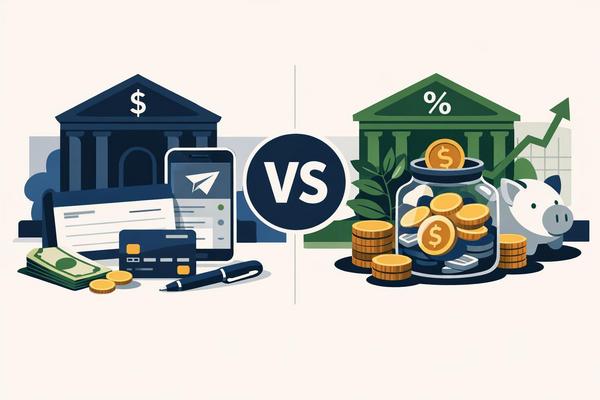
Your checking account is your working account. It’s built for transactions — direct deposit, debit card purchases, rent, utilities, groceries, gas, Venmo transfers, and automatic bill pay. Your savings account is the opposite. It’s meant to hold money, not constantly move it around. You can transfer in and out, but the point is to separate cash you don’t plan to spend this week.
That sounds obvious, but in real life a lot of people use savings like a backup checking account. They overspend, move money over, overspend again, and repeat the cycle. At that point, the savings account stops being savings. It just becomes checking with extra steps.
There’s also a psychological difference worth noting. Checking feels available. Savings feels reserved. That mental line matters because personal finance isn’t just math — it’s behavior.
Why People Blur the Line Between the Two
If all your money sits in checking, it’s easy to think you have more available than you really do. You look at the balance, see $2,400, and forget that rent, car insurance, and the electric bill are all about to hit. The number looks comforting right up until it doesn’t.
If all your extra cash sits in savings but you keep pulling from it for takeout, Amazon orders, and random weekend spending, you never create any real separation. Your account labels say one thing. Your habits say another.
This happens because most people were never taught how to assign jobs to their money. They were just told to “save more.” That advice isn’t wrong — it’s just incomplete. You don’t save consistently by having good intentions. You save consistently by making your accounts work the way they were designed to work.
A Simple Setup That Works in Real Life
The easiest way to use both accounts effectively is to let checking handle your monthly life and let savings protect your future life.
Your checking account should hold money for:
- Paychecks after direct deposit
- Rent or mortgage
- Utilities and phone bill
- Groceries and gas
- Minimum debt payments
- Subscriptions and other planned monthly spending
Your savings account should hold money for:
- Emergency fund money
- Car repairs
- Medical bills you didn’t see coming
- Travel you’re planning ahead for
- Irregular expenses like gifts, insurance deductibles, or back-to-school shopping
The key isn’t just having both accounts. It’s deciding that money in savings isn’t there to cover routine overspending in checking. If you keep bailing out checking for normal stuff, you never learn what your spending actually looks like.
If Your Paycheck Disappears Fast, Start Here
Use checking for the next 30 days of spending and use savings for everything beyond that. If the money is for bills or spending that’ll happen before your next paycheck, checking makes sense. If it’s for a problem you hope doesn’t happen or a goal that’s still down the road, it belongs in savings. Checking is your money for now. Savings is your money for later. Mix them together and later keeps losing.
How to Make Both Accounts Work Together Without Overthinking It
You don’t need a complicated system to get this right. You need a repeatable flow. When your paycheck comes in, let it land in checking. From there, bills stay in checking, everyday spending stays in checking, and a planned amount moves to savings automatically.
That automatic transfer matters because it removes the need to make the same saving decision over and over. If you wait to save “whatever is left,” there usually won’t be much left. Life is too expensive and too random for that approach. A basic system looks like this:
- Paycheck hits checking
- Fixed bills get paid from checking
- Spending money stays in checking for the week
- A set amount moves to savings every payday
- You only pull from savings for true planned goals or real emergencies
This also helps you see whether your budget is the real problem. If checking keeps running dry before the month is over, the answer might not be “save less.” It might mean your housing costs, debt payments, or day-to-day spending are out of line with your income.
What Counts as an Emergency — and What Doesn’t
Your emergency fund is for things that are urgent, necessary, and unplanned. A flat tire on the way to work counts. A surprise urgent care bill counts. Your hours getting cut at work counts. Concert tickets don’t. Holiday shopping usually doesn’t, because December is not a surprise. Neither is your annual car registration, your friend’s birthday, or school supplies for your kids. Those are irregular expenses, not emergencies. You can still save for them — they just shouldn’t live in the same mental bucket as true emergency money.
The Mistake That Keeps People Stuck
When all your cash feels equally spendable, you make decisions based on today’s balance instead of tomorrow’s needs. That’s how people end up saying, “I had money, but I don’t know where it went.”
Checking and savings fix that problem when you use them on purpose — checking shows what you can work with right now, and savings protects money from your own short-term habits.
Most people use these accounts without understanding what each one is actually designed to do. Once you get that, you stop seeing them as interchangeable and start using them as tools. Checking is for spending, savings is for protecting, and your money gets easier to control when each account has one clear job.
If this clicked, the next thing worth understanding is how emergency funds actually work when your budget is already tight.