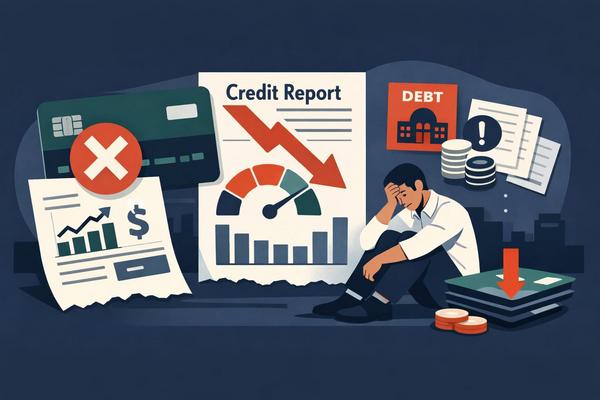
Your card stopped getting paid, the account got closed, and now your credit report says “charge-off” — like the debt somehow vanished. It didn’t.
What a Charge-Off Actually Means
A charge-off is an accounting move, not a debt eraser. When a credit card account goes seriously delinquent — usually around 180 days past due — the lender stops treating it like an active account and marks it as a loss on its books. That status shows up on your credit report as a charge-off. A lot of people see that label and assume the creditor wrote it off and moved on, but that’s the part that trips people up. The debt usually still exists, and you can still be asked to pay it. The original creditor might keep collecting, send it to a collection agency, or sell it to a debt buyer.
In real life, a charge-off means the situation got worse, not better. You missed enough payments that the lender stopped expecting normal repayment — and that’s why this mark is one of the more serious negatives you can have on a credit report, short of bankruptcy, foreclosure, or repossession.
Why Lenders Do This After Months of Missed Payments
Lenders have rules for when unpaid debt has to be treated as a loss for accounting and regulatory purposes. For revolving accounts like credit cards, that point is typically after 180 days of nonpayment. A charge-off doesn’t usually appear out of nowhere — it’s the end result of a string of late payments, penalty fees, rising balances, and repeated delinquency reporting.
By the time the account is charged off, your credit report often already shows a rough pattern: 30-day late payments, then 60-day, then 90-day, then 120-day or worse delinquency, and finally a closed account or charge-off status. That’s one reason the damage can feel so heavy. You’re not dealing with one bad mark — you’re dealing with a chain of them that built up over months.
What It Does to Your Credit Score
A charge-off can knock your score down hard because it tells future lenders you didn’t just fall behind — you defaulted. The exact point drop depends on where your score started, what else is on your report, and how recent the charge-off is. Someone with otherwise strong credit can see a bigger drop than someone whose credit was already struggling. Either way, it’s bad news.
Credit scoring models care a lot about payment history — that’s the biggest factor in most scores. A charge-off signals serious nonpayment, and that can affect your ability to qualify for new credit cards, car loans, apartments, and sometimes even jobs that check credit. The missed payments leading up to the charge-off and any collection account that follows can stack more damage on top, which is why this can feel like you’re getting hit from three directions at once.
Does Paying It Remove the Damage?
Usually, no. Paying a charged-off account doesn’t erase the fact that it was charged off. The record can stay on your credit report for up to seven years from the date of first delinquency that led to the charge-off — and that date controls how long the mark can remain. What payment can do is update the status. Instead of showing an unpaid charge-off, it may show as paid or settled. That’s still negative, but it’s generally better than leaving it unpaid. Future lenders may see that you resolved the debt instead of ignoring it.
The Debt Doesn’t Disappear
This is the part people really need to understand: a charge-off does not mean you’re off the hook. It means the creditor changed how it reports the account for its own books. Your legal obligation to pay may still be there unless the debt is discharged in bankruptcy, forgiven, or becomes legally uncollectible under state law.
Even after charge-off, a few things can happen. The original creditor keeps trying to collect. The account gets assigned to a collection agency or sold to a debt buyer. You get offered a settlement for less than the full balance. Or you get sued, depending on the balance and your state’s laws. That’s why ignoring a charge-off can get expensive fast — interest may have already grown the balance before the account was closed, and in some cases your wages or bank account could be at risk if a collector sues you, wins, and state law allows enforcement.
What About the Statute of Limitations?
The statute of limitations is the window during which a creditor or collector can sue you for the debt. It depends on your state and the type of debt, and it’s a completely separate clock from the credit reporting timeline. A debt can still appear on your credit report even if the lawsuit window has passed, and a debt can still be legally collectible before it falls off your report. Mixing those two timelines up causes a lot of confusion — don’t.
If This Is on Your Report, Here’s How to Handle It
You don’t need to panic, but you do need a plan. The smartest move depends on whether the information is accurate, whether the debt is still within your state’s statute of limitations, and whether you can afford to resolve it.
Start by pulling your credit reports and looking closely at the charged-off account. Check the balance, account status, payment history, and date of first delinquency. If anything looks wrong — balances that don’t add up, duplicate reporting, or a timeline that seems off — dispute the inaccurate information with the credit bureaus.
Next, figure out who actually owns the debt. If the original creditor still holds it, you may be able to work directly with them. If a collector owns it, get the details in writing before you send a dime. You want to know who has the legal right to collect and exactly how the account will be reported if you pay or settle.
From there, think through your options: pay the full balance, negotiate a settlement for less than owed, set up a payment arrangement, or — if money is tight — focus first on keeping current accounts current. Preventing new late payments may matter more right now than cleaning up an old charge-off.
How It Follows You Beyond Your Credit Score
A charge-off can show up in places that don’t seem connected at first. You might get denied for a new apartment, pay a higher security deposit for utilities, or end up with worse loan terms when you need a car for work. It affects your options, not just a number on a screen.
It also tends to hit when money is already stretched thin. People don’t usually end up with charge-offs because they forgot one bill — it’s more often a stretch where rent, groceries, gas, or a job loss knocked everything sideways at once. Understanding that doesn’t remove the consequences, but it does help you focus on the fix instead of the shame.
The Bottom Line
A credit card charge-off means the lender marked your account as a loss after months of nonpayment — but the debt usually still remains, and the credit damage can stick around for years. It didn’t disappear. It just got worse, and the consequences keep following you until you deal with them.
If this made sense, the next thing worth understanding is the difference between a charge-off and a collection account — and why that distinction matters when you’re trying to clean things up.