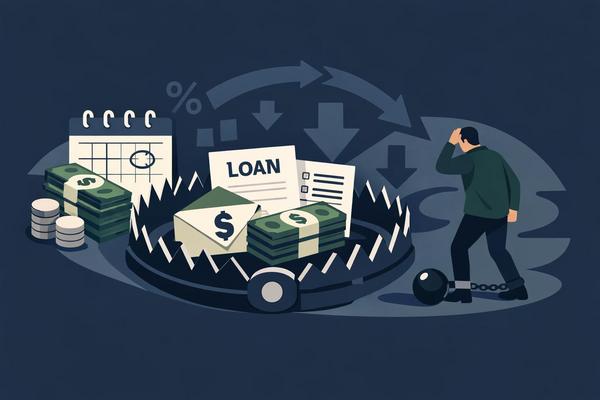
Your rent is due, your account is low, and a payday loan looks like the fastest way to keep everything from falling apart.
When you’re short on cash and the bills don’t care, payday lenders know exactly how to look helpful. They offer quick money, barely ask questions, and make it sound like you’re just borrowing a little to get through the week.
The problem is that payday loans usually aren’t built to solve a short-term emergency. They’re built around the fact that most people can’t afford to repay the whole thing — plus fees — out of their next paycheck. That’s where the trap begins.
How Payday Loans Actually Work
A payday loan is a small, short-term loan that’s supposed to be repaid when you get paid again — usually within two weeks. You might borrow a few hundred dollars to cover groceries, gas, rent, a utility bill, or a car repair. The lender gives you the money fast, then expects repayment in one lump sum that includes what you borrowed plus a flat fee.
On paper, the fee may not sound outrageous. Maybe it’s $15 or $20 for every $100 borrowed. But that fee is attached to an extremely short repayment window, and when you convert it into an annual percentage rate, the cost can shoot into the triple digits. That’s why payday loans end up being far more expensive than credit cards, personal loans, or even most overdraft fees.
Here’s the basic setup:
- You borrow a small amount, often $100 to $500
- You agree to repay it by your next payday
- The lender charges a fee based on how much you borrow
- If you can’t pay the full amount on time, you may renew, roll over, or take out a new loan
That last part is where things go sideways for a lot of people.
Why the Debt Cycle Starts So Easily
If you needed a payday loan in the first place, chances are your next paycheck was already spoken for — rent, groceries, your phone bill, your car payment, child care, or just catching up on stuff that was already late. Now add a payday loan payment on top of that.
Let’s say you borrow $300 because you’re short before payday. Two weeks later, you owe $345. If your paycheck barely covered your normal life before, where is that extra $345 supposed to come from? For a lot of borrowers, the answer is simple and brutal: it doesn’t. So they extend the loan, pay another fee, or take out a new payday loan to cover the old one. The original emergency may be over, but the borrowing isn’t.
It Feels Temporary Because That’s How It’s Sold
Payday lending is built on a story people want to believe when they’re stressed. Just get through this week. Just cover this one bill. Just make it to your next paycheck. That story falls apart because the loan doesn’t fix the gap in your budget — it usually makes the next gap bigger. If you were short $300 this pay period, paying back $345 next pay period means you’re starting even further behind than before.
Legal Doesn’t Mean Safe
A lot of people assume that if payday loans are legal, the terms can’t be that bad. That’s a reasonable assumption, and it’s wrong. Payday loans are legal in most states, though the rules vary a lot depending on where you live. Some states cap fees or limit rollovers. Others allow much looser terms. Some have banned payday lending entirely or pushed lenders into different loan structures.
Legality is not the same thing as consumer-friendly design. Plenty of financial products are legal because they meet state rules, not because they help borrowers build stability. Payday loans survive because they fill a real need — people need cash fast, banks often won’t make tiny emergency loans, credit scores may already be damaged, and savings may be gone. When your lights are about to get shut off, you don’t always have time to shop for the ideal option. Lenders know that, which is why speed and convenience are a huge part of the pitch.
Who Gets Trapped Most Often
The payday loan trap doesn’t happen because borrowers are careless. It happens because they’re under pressure — unpredictable work hours or gig income, no emergency fund, a surprise medical bill or car repair, late rent, a utility shutoff notice, or existing credit card debt already piling up. Payday loans tend to hit people who already have the least room for error, and that’s what makes the cycle so hard to break.
What to Do Before You Take One
If you’re staring at a bill and thinking about a payday loan, the first question isn’t whether you can get approved. It’s whether your next paycheck can absorb the full repayment without creating a bigger mess. If the answer is no, that loan probably isn’t solving your problem — it’s just delaying it and adding fees.
Before you borrow, try to slow the clock down on the emergency itself:
- Call your landlord, utility company, or medical provider and ask for extra time
- Request a payment plan instead of paying the full amount at once
- Check whether your bank or credit union offers a lower-cost small-dollar loan
- Ask family or friends for a short-term bridge if that’s realistic for you
- Look for local nonprofit or community assistance for rent, food, or utilities
None of those options feels great when you’re stressed, and some take time you may not feel like you have. But they’re almost always cheaper than entering a cycle where every payday starts with an old debt taking a bite out of your check.
If You’re Already in the Cycle
If you’ve already taken out a payday loan, don’t waste energy beating yourself up. The product is designed to look manageable right before it gets expensive. Your job now is to stop the repeat borrowing if you can.
Start by getting brutally honest about the next 30 days of cash flow. Write down what’s definitely coming in and what absolutely has to go out — housing, food, utilities, transportation. Contact the lender and ask what your options are under your state’s rules. Then focus on avoiding the pattern where every shortage gets patched with another high-cost loan. That may mean negotiating other bills, picking up extra hours, or getting outside help for a month or two while you reset.
The Bottom Line
Payday loans make sense only if you look at the emergency in front of you and ignore what comes next. Once you look at the full repayment picture, it becomes clear — these loans are often structured in a way that keeps you borrowing long after the original emergency is over. That’s the trap.
If this made sense, the next thing worth understanding is why overdraft fees and late fees hit hardest when your budget is already stretched thin.