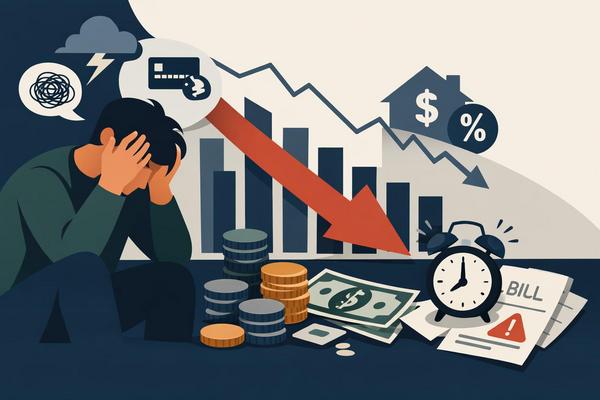
Your credit card balance is sitting there, bills are due, and opening your banking app feels weirdly harder than it should.
Financial anxiety doesn’t just live in your head — it shows up in your sleep, your relationships, and the way you keep putting off looking at your money. If you’ve ever let a bill sit unopened, ignored a low balance alert, or told yourself you’ll deal with it next weekend, you’re not lazy and you’re not uniquely bad with money. You’re having a completely normal reaction to stress.
The problem is that money stress pushes you to do the exact things that make money problems worse. You avoid the numbers because they make you anxious, and then the numbers get more expensive, more urgent, and harder to face. That’s the loop. Breaking it starts with understanding that the fear itself is part of the financial problem.
Why Money Stress Hits So Hard
A lot of financial anxiety comes from uncertainty, not just from being broke. Your brain can handle bad news faster than it can handle vague, floating dread. Not knowing whether your checking account will cover groceries, gas, rent, and the minimum payment on your card is mentally exhausting — because money isn’t abstract. It touches housing, food, transportation, childcare, medical bills, and your basic sense of stability. When one part feels shaky, everything else can feel shaky too.
There’s also a structural reason this is so common right now. A lot of people are trying to cover basic life with incomes that haven’t kept up with rent, insurance, groceries, and interest charges. Even if you’re working hard and doing a lot right, the math may still feel tight. That doesn’t mean every money problem is caused by the economy, but it does mean your stress isn’t always coming from personal failure. Sometimes you’re reacting to real pressure, and that’s worth acknowledging.
The Avoidance Trap Is Expensive
Money anxiety gets dangerous when it turns into money avoidance. That can look small at first — you don’t check your account for a few days, you put off opening a medical bill, you skip the budget because you already know it’s going to be ugly. None of that sounds dramatic in the moment. But over time, avoidance creates overdraft fees, late fees, missed due dates, interest charges, and bigger balances.
It also takes away your ability to make useful decisions. If you don’t know what’s in the account, what bills are due, or how much debt is growing, you can’t really choose your next move — you’re just reacting. And reacting is expensive. That’s why people can feel like they’re always trying hard with money and still falling behind. The goal isn’t to become fearless about money. It’s to stay in contact with reality long enough to make better choices.
What Managing Money Stress Actually Looks Like
You don’t need a perfect budget or a total life overhaul to lower financial anxiety. You need a few steady habits that make your money less mysterious. The more visible your situation becomes, the less power your imagination has to make it feel even worse. That doesn’t mean the numbers will be fun — it means they’ll be concrete. Concrete is easier to handle than doom.
Start With a Five-Minute Money Check
Pick one time of day to look at your money. Maybe it’s five minutes at the kitchen table after dinner, or every morning before work. Keep it short on purpose — you’re building tolerance, not trying to become a spreadsheet warrior overnight. Look at just three things: your checking account balance, what bills are due in the next seven days, and your current credit card balance. If that’s all you do this week, that’s still progress. Consistency matters more than intensity when you’re trying to calm financial anxiety.
Make the Next Decision Smaller
One reason money feels overwhelming is that your brain turns it into one giant problem. Debt, bills, savings, retirement, taxes, emergency fund — all of it lands on your chest at once, and that shuts people down. Instead of asking, “How do I fix my finances?” ask, “What’s the one money decision I need to make by Friday?” That question is answerable. Maybe it’s calling the utility company, moving a due date, canceling two subscriptions, or figuring out how much cash is safe for groceries this week. Small decisions don’t solve everything, but they get you moving again.
Build a Bare-Minimum Plan for Rough Weeks
You need a version of your money plan that works when you’re stressed, tired, and not at your best. This is your survival budget — not your ideal budget. List the bills and categories that protect your basic life first: housing, utilities, groceries, gas or transportation, insurance, and minimum debt payments. When money is tight, this list cuts through the panic. It reminds you what gets paid first, and everything else is secondary until the essentials are covered. That kind of clarity lowers stress because it gives your dollars a job before emotion grabs the wheel.
If You’ve Ever Felt Like the System Is Working Against You
Most money stress isn’t solved by one big breakthrough — it’s eased by reducing friction in daily life. You want to make the helpful actions easier and the expensive mistakes harder. That can be very ordinary stuff: set calendar reminders a few days before due dates, put bills on autopay only if your checking balance is predictable enough, keep a running note on your phone with upcoming expenses, and give yourself a 24-hour pause before nonessential purchases. These aren’t glamorous tricks. They’re guardrails, and guardrails matter when your brain is tired and your finances feel emotional.
It also helps to stop treating every money mistake like evidence about your character. A late fee is frustrating — it’s not proof that you’re irresponsible forever. A month where you leaned too hard on credit cards is a problem to solve, not a moral verdict. Shame makes people hide. Honesty makes adjustment possible. If you want less financial anxiety, you have to replace self-judgment with useful information.
When the Stress Is Telling You Something Real
Not all financial anxiety is irrational. Sometimes it’s your mind correctly picking up that the numbers don’t work right now. If your income doesn’t cover your essentials, no mindset shift is going to make that feel okay. In that case, managing money stress means facing the shortfall directly — cutting fixed costs, increasing income, asking for due date changes, or making a temporary plan just to stabilize the next month or two. That can feel discouraging, but it’s still better than staying in the dark. Reality is where your options live.
If money stress is affecting your sleep, your relationships, or your ability to function day to day, take that seriously. Financial anxiety is common, but common doesn’t mean harmless. Once you can look at your money clearly — even for just a few minutes at a time — you give yourself a real chance to interrupt the cycle.
Financial anxiety is real, it’s widespread, and it pushes people to avoid their money in ways that make everything worse. The most helpful move is steady, honest contact with the numbers. If this made sense, the next thing worth understanding is how to build a simple budget when your income barely covers the basics.