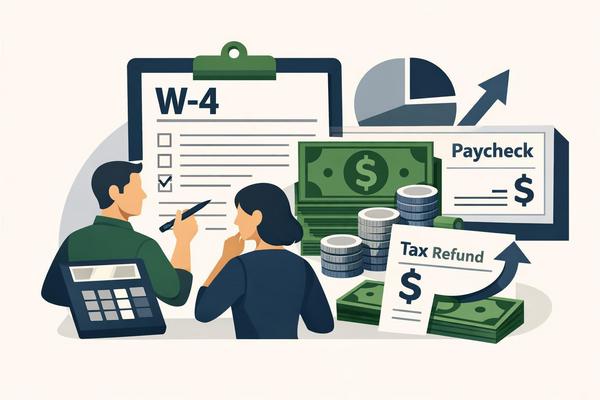
Your paycheck looks smaller than it should, or your tax refund keeps showing up like a forced savings account — and the culprit is usually a W-4 you filled out once and never touched again.
What a W-4 Actually Does
Your W-4 tells your employer how much federal income tax to take out of each paycheck. That’s it. It doesn’t decide how much tax you owe for the year — it just helps your employer estimate how much to withhold as you go. If that estimate is off, the difference shows up later as either a refund or a tax bill.
When you start a new job, HR usually hands you a W-4 with a stack of other paperwork. Most people fill it out fast, guess through a few boxes, and never think about it again. That’s normal — and it’s also why a lot of people end up with too much or too little tax coming out of their checks for years.
The W-4 withholding form affects your take-home pay every single payday and your tax refund when you file. More withholding means a smaller paycheck now and a bigger refund later. Less withholding means a bigger paycheck now and a smaller refund later — or possibly a tax bill if you go too far.
Why Your W-4 Matters More Than You Think
You probably notice your net pay a lot more often than you think about tax season. That makes sense. Rent is due every month. Groceries, gas, daycare, and credit card payments hit all year long. Your W-4 quietly shapes how much cash you have left for all of that.
If you filled out your W-4 once and never updated it, there’s a good chance it no longer matches your real life. Maybe you got married, had a kid, picked up a second job, or started freelance work. Maybe your spouse started working or stopped. Any of those changes can shift what your withholding should look like.
The tax system is built around withholding throughout the year instead of one giant payment in April. Your employer uses your W-4 plus your wages and payroll schedule to estimate what to send to the IRS. That estimate works fine when your situation is simple. It gets messy fast when your income changes or your household has more than one earner.
Big Refund, Small Refund, or a Surprise Tax Bill?
A tax refund is usually not free money. Most of the time it means you paid more through withholding than you actually owed, and the IRS is just giving your own money back. That’s why a huge refund can feel great in spring and still mean you were short on cash all year.
Think about it this way. If an extra $150 was being withheld from every monthly paycheck, that’s $1,800 over a year. You might get that back as a refund — but meanwhile you spent the year juggling bills, carrying a credit card balance, or skipping contributions to savings because your paycheck felt tight.
An outdated W-4 can quietly cost you money every month, even if you eventually get it back. Money tied up in over-withholding can’t help with cash flow, debt payoff, emergencies, or everyday life. And if inflation has been squeezing your budget, that matters even more.
Too little withholding creates the opposite problem. Your paycheck looks better now, but tax season can turn ugly fast. If not enough was withheld, you may owe the IRS money — and sometimes penalties on top of that. The goal isn’t to game the system. It’s to get close.
What Throws People Off on the Current Form
Older versions of the W-4 used allowances, and a lot of people still think in those terms. The current form dropped allowances entirely. Now it asks more directly about filing status, multiple jobs, dependents, and any other income or deductions you want factored in.
That sounds simpler, but plenty of people still rush through it and miss the parts that matter most. The biggest trouble spot is Step 2, which covers multiple jobs or a working spouse. If your household has more than one paycheck and that section isn’t handled right, withholding can end up way off — because each employer mostly only sees what they pay you. If two jobs both withhold like they’re your only source of income, you can end up under-withholding without realizing it until April shows up with bad news.
Signs Your W-4 Needs a Fresh Look
You don’t need to revisit this every month. But you do want to check it when life changes or when your tax result keeps surprising you.
- You got a huge refund and would rather have more in each paycheck.
- You owed taxes last year and don’t want that happening again.
- You got married, divorced, or had a child.
- You started a second job or your spouse’s work situation changed.
- You have side income with no withholding attached to it.
- Your deductions or tax credits changed in a meaningful way.
If any of that sounds familiar, your current withholding may be stale. A lot of people treat the W-4 like a one-time onboarding form. It’s really more like a settings page for your paycheck — one that should reflect where you are now, not where you were when you first got hired.
How to Actually Fix It
Adjust your W-4 when your life changes, not just when tax season goes sideways. You don’t need to guess blindly. Pull up your most recent pay stub, last year’s tax return, and your current household income picture. That gives you a much better shot at getting withholding close to right.
What you’re aiming for depends on your priorities. Some people like a modest refund because it acts like a buffer. Others want the biggest accurate paycheck possible so they can control that money themselves — put it toward a 401(k), pay down debt, or just cover the month without stress. Either approach can work. The problem is drifting into a result you didn’t choose.
- If your refund is consistently very large, consider reducing withholding so more money stays in your paycheck throughout the year.
- If you keep owing money at filing time, increase withholding before the problem compounds.
- If you have multiple jobs, pay close attention to the multi-job section of the form.
- If you earn freelance or side-gig income, your W-4 at your main job may need to account for those earnings too.
You can usually submit a new W-4 through payroll or your HR portal. Then check a later pay stub to confirm the withholding actually changed the way you expected. It’s one of those small admin tasks that can improve your monthly cash flow without changing your income at all.
The Bottom Line
Your W-4 is one of the levers that controls how much of your own money you get to use during the year. Set it once and ignore it forever, and you’re letting an old estimate run your current paycheck. Most people do exactly that — and it’s exactly how they end up giving away cash flow they could’ve used all year long.
If this made sense, the next thing worth understanding is why getting a raise can still leave your paycheck feeling smaller than you expected.