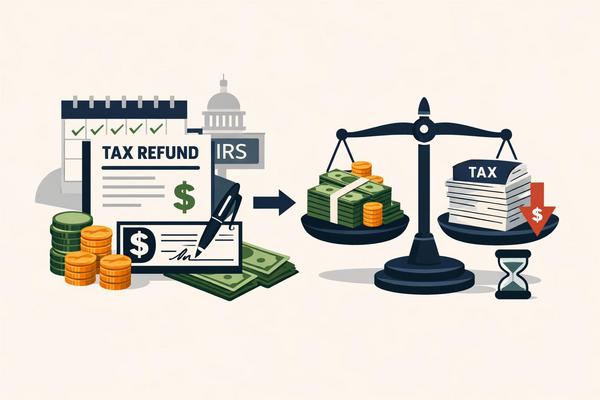
Your grocery bill is higher, your rent went up, and your paycheck barely moved — and then a fat tax refund lands in your account and suddenly everything feels fine. That’s the trap.
A tax refund isn’t free money. In most cases, it’s your own money coming back after you overpaid taxes little by little from every paycheck. That’s why people say a huge refund means you gave the government an interest-free loan all year.
Why a Refund Happens in the First Place
When you get paid, your employer withholds money for federal income taxes based on your W-4, your pay, and IRS withholding tables. That’s just an estimate — not your final tax bill. Your real bill gets calculated when you file your return. If too much was withheld, you get a refund. If too little was withheld, you owe money.
A refund is basically a true-up. It’s not a prize for filing, and it doesn’t mean the IRS handed you extra cash out of nowhere.
Why a Large Refund Means Your Paycheck Was Smaller Than It Needed to Be
Let’s make it concrete. Say your refund is $3,600. That sounds great in April. But spread over 12 months, that’s about $300 a month withheld beyond what you actually needed to cover your tax bill — $300 that could’ve stayed in your checking account for groceries, your emergency fund, debt payoff, or just making your budget less tight every month.
That doesn’t mean every refund is bad. It means the refund itself isn’t the win people often think it is. The real question is whether you would’ve been better off having that money throughout the year instead of waiting for the IRS to send it back.
It Feels Like a Windfall Because of Timing
Part of the confusion is psychological. A big lump sum feels different from small amounts spread across 26 paychecks. You barely notice an extra $100 or $150 in a paycheck after taxes, insurance, and 401(k) contributions. But a few thousand dollars at once feels meaningful.
That’s why some people actually like getting a refund — it acts like forced savings. They know if the money showed up gradually, they’d probably spend it. That’s understandable, but it’s still not the same as making money. You’re just getting back what was yours, and unlike money sitting in a savings account, it wasn’t earning you a dime while the government held it.
When a Refund Is More Than Just Overwithholding
There’s one important wrinkle. Some refunds are boosted by tax credits, not just overpayment. Credits like the Earned Income Tax Credit or the Child Tax Credit can push your refund beyond what you had withheld — so part of it can be real tax relief, not just your own money coming back. Even then, the overwithholding portion still works the same way. If too much came out of your paycheck during the year, that slice of the refund still reflects money you could’ve had earlier.
If Money Feels Tight Every Month but You Get a Big Refund Every Spring
That’s a clue your monthly cash flow may be worse than it needs to be. Maybe you’re carrying a credit card balance at 22% interest while waiting on a refund. Maybe you’re dipping into savings for car repairs even though a few extra hundred dollars a month would’ve covered it. Maybe you’re stressed about bills in October and then flush with cash in March.
That mismatch matters more than the emotional high of refund season. Personal finance works better when your money shows up when you actually need it. A more accurate paycheck can make day-to-day life easier, even if it means a smaller refund later.
Should You Try to Get Your Refund Close to Zero?
For a lot of people, yes. The ideal setup is usually a small refund or a small amount owed — that means your withholding was close to your real tax bill. You didn’t overpay all year, and you didn’t get hit with a painful surprise at filing time.
That said, there’s no one perfect number for everybody. If you’re self-employed, have side income, get bonuses, or your household income shifts during the year, your taxes can get complicated fast. Some people prefer a modest refund because it gives them a margin of safety. The goal isn’t to chase a refund or to owe nothing. The goal is to make your withholding match reality as closely as you reasonably can.
A Practical Way to Adjust Your Withholding
If your refund was much bigger than expected, take a look at your W-4. You can update it through your employer, and the IRS has a Tax Withholding Estimator that helps you check whether too much is being withheld. It’s especially worth revisiting if any of these changed recently: you got married or divorced, started a second job, your spouse changed jobs, you had a child, picked up freelance or gig income, or your pay went up or down.
Even a small adjustment can improve your monthly cash flow. You don’t need to get your refund to exactly zero to benefit. If your refund is huge, getting closer to accurate is usually enough.
The Better Way to Think About a Tax Refund
Enjoy the money if it’s coming your way. There’s nothing wrong with feeling relieved when that deposit lands. Just don’t mistake that feeling for profit. A tax refund is mostly a sign that your withholding and your actual tax bill didn’t line up — and when the refund is large, too much of your money left your paycheck and sat with the government until tax season.
A big tax refund feels like a windfall, but it usually means you overpaid taxes all year and gave the government an interest-free loan.
If this made sense, the next thing worth understanding is how your W-4 actually controls the size of your paycheck — and how a few simple changes can put more money in your hands every month instead of once a year.