Your money’s sitting in cash while the market feels confusing, expensive, and way too easy to mess up.
If you’re new to investing, the hardest part usually isn’t opening an account. It’s figuring out what to buy without feeling like you’re one bad decision away from losing everything.
You hear people talk about stocks, index funds, mutual funds, retirement accounts, and ticker symbols like everyone got a class on this except you.
An ETF is one of the simplest ways to get started because it lets you buy a whole basket of investments in one move. That’s the short version. The longer version matters, because once you understand how ETFs work, investing gets a lot less intimidating.
What Is an ETF in Plain English?
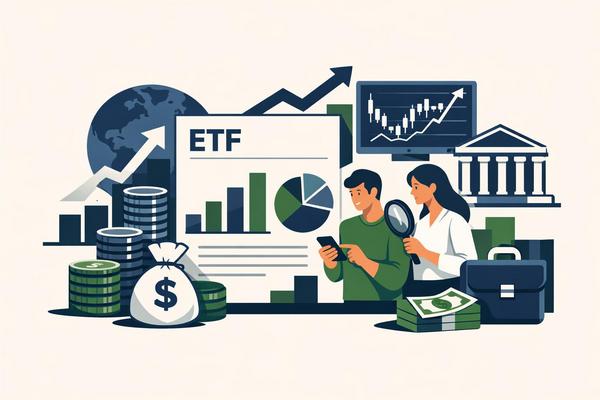
ETF stands for exchange-traded fund. An ETF is a fund that holds a group of investments, and you buy shares of that fund on the stock market. Instead of buying one company at a time, you can buy a slice of many companies all at once.
Think of it like buying the whole shelf instead of picking one item off it. One ETF might hold hundreds of large U.S. companies. Another might track small companies, bonds, international stocks, or a specific sector like health care or energy. When you buy one share of an ETF, you’re buying a tiny piece of everything inside it.
That’s the part beginners usually miss. You’re not making a high-pressure bet on one stock — you’re spreading your money across a lot of investments right away.
Why Beginners Get Stuck on Individual Stocks
A lot of new investors assume investing means finding “the right stock.” That’s mostly because individual stocks get all the attention. People talk about Nvidia, Apple, Tesla, and whatever’s making headlines that week, which creates the impression that successful investing is about picking winners early.
In real life, most beginners don’t need a hot stock pick — they need broad exposure and fewer ways to screw it up. Buying one stock means your outcome depends heavily on one company. If that company stumbles, your investment takes the hit. Layoffs happen, sales slow down, management makes bad calls, and the market overreacts. That’s a lot of risk to carry if you’re just trying to build wealth over time.
An ETF reduces that problem because one company doesn’t make or break the whole investment. If one stock inside the fund falls, the others are still there. You’re not putting your financial future on one horse.
How an ETF Actually Works
Most beginner-friendly ETFs are built to track an index — just a list of investments that represents part of the market. The S&P 500, for example, tracks 500 large U.S. companies. If you buy an ETF that follows the S&P 500, your money is spread across those companies in one purchase.
ETFs trade during the day like stocks. You can buy them in a brokerage account, a Roth IRA, or often inside a 401(k) if your plan offers them. The price moves up and down while the market is open, but what you own underneath is a fund, not one company. Most ETFs also carry low fees, especially broad market index ETFs — and those fees matter more than people think. High costs year after year is money not staying invested for you.
A Quick Example
Say you have $200 to invest. You could put it all into one company and hope that company does well. Or you could buy shares of an ETF that holds hundreds of companies, and now your $200 is working across a much wider part of the market. You’re still taking market risk — investing always involves risk — but you’re avoiding the extra risk that comes from being overly dependent on one company.
ETF vs. Mutual Fund: What’s the Real Difference?
Both can hold a basket of investments, so you’ll hear these two compared a lot. The difference is mostly in how they’re bought and sold. ETFs trade on the exchange during the day. Mutual funds are usually priced once per day after the market closes.
For a beginner, the bigger takeaway is this: both can diversify you, but ETFs are often easier to understand, easier to access, and cheaper. That doesn’t make mutual funds bad — plenty of retirement plans use them — but if you’re learning the basics in a regular brokerage account or IRA, ETFs are usually the cleaner starting point.
What Kind of ETF Makes Sense for a First Investment?
Not every ETF is built for the same job. Some are broad and boring in a good way. Others are narrow, trendy, or highly speculative. If you’re just starting out, broad-market ETFs usually make the most sense. These are the kinds most beginners look at first:
- Total U.S. stock market ETFs
- S&P 500 ETFs
- Total international stock ETFs
- Bond ETFs for people who want less volatility
The common thread is diversification. You’re trying to own a wide piece of the market, not chase whatever’s hottest on social media. A good first ETF usually feels a little boring — and that’s often a sign you’re doing it right. Neither does contributing to your 401(k), paying down your credit card, or building an emergency fund. But boring is often what works in personal finance.
Where ETFs Fit Into Your Actual Life
If you’re working, paying rent or a mortgage, buying groceries, and trying to get ahead, you probably don’t have time to analyze quarterly earnings reports for ten companies. You need an approach you can stick with. ETFs work well for regular people because they simplify the decision while still giving you real exposure to long-term market growth.
That matters whether you’re investing for retirement, a future down payment, or just trying to stop relying on cash that loses ground to inflation over time. With an ETF-based approach, you can focus more on habits than predictions — things like investing consistently each month, using tax-advantaged accounts like a Roth IRA or 401(k), keeping fees low, and staying invested during market ups and downs. That’s how most people actually build wealth. Not by outsmarting Wall Street every Tuesday.
What ETFs Won’t Do for You
ETFs make investing easier, but they don’t remove risk. If the overall market drops, a broad stock ETF will usually drop too. You can still lose money in the short term, and that’s normal. An ETF is a smart tool, not a magic shield.
This is why your time horizon matters. Money you need for next month’s rent or next semester’s tuition doesn’t belong in a stock ETF. Money meant for long-term goals usually has more room to ride through market swings. It’s also worth knowing that some ETFs are far riskier than others — a broad index ETF is very different from a leveraged ETF or one built around a narrow trend. Just because something has “ETF” in the name doesn’t automatically make it simple or safe.
The One Thing to Take Away From This
You don’t need to become a stock-picking expert to start investing wisely. You don’t need to guess which company will dominate the next decade. An ETF lets you own a slice of hundreds of companies at once, which is why it’s often the smartest first investment for a beginner — it gives you diversification, simplicity, and a structure that’s easier to live with when the market gets noisy. For most people, that’s a much better foundation than trying to hit a home run with one stock.
If this made sense, the next thing worth understanding is how index funds differ from ETFs and why the gap between them is smaller than most people think.