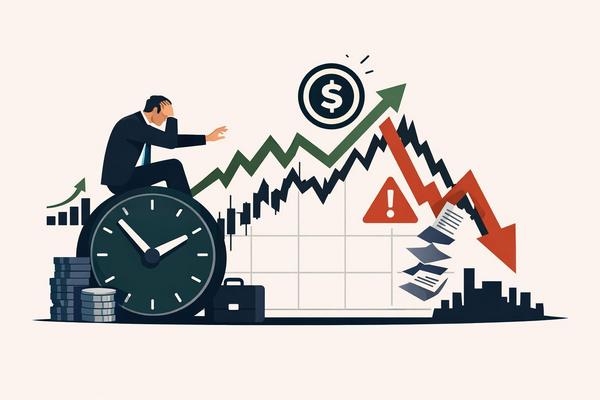
Your cash is sitting on the sidelines because you’re waiting for the right moment to invest — and that moment never quite feels like it’s here.
You can probably make a decent case for waiting. Stocks feel expensive, the news sounds bad, interest rates are still a thing, and every other headline hints that a drop is coming.
That logic feels smart, but it’s exactly why market timing fails for so many regular investors.
The hard part isn’t predicting that the market will swing — it always does. The hard part is knowing when to get out, when to get back in, and how not to miss the handful of days that drive a huge chunk of long-term returns. That’s where most people get burned.
Why Waiting Feels Safer Than Investing
If you’re holding cash because the market feels shaky, you’re not being irrational. You’re reacting like a normal person. Losses hurt more than gains feel good. If your 401k drops 15% in a few months, that sticks with you a lot longer than a slow year of steady gains.
On top of that, the financial media is built to make uncertainty feel urgent. Every Fed meeting, jobs report, inflation print, and geopolitical mess gets framed like a moment when you need to do something right now.
That constant noise makes investing feel like a test of timing, even when long-term investing works better as a test of patience.
Waiting also gives you the illusion of control. You tell yourself you’ll invest after the next dip, after the election, after rates come down, or after the economy looks more stable. The problem is those goalposts keep moving. By the time things look safe again, prices have usually already moved up.
The Market’s Best Days Don’t Send Invitations
Here’s the part that makes timing the stock market harder than it looks. The biggest up days often happen right around the ugliest down days — when fear is still high, headlines still sound terrible, and most people feel least comfortable buying.
That’s not just frustrating. It’s structural. Markets reprice fast. When expectations get too pessimistic, even a small shift in sentiment can trigger a huge rally. If you’re waiting for reassurance, you’re usually late.
Missing just the 10 best market days in a decade can cut your returns in half. The exact numbers vary depending on the time period, but the lesson stays the same. A surprisingly small number of trading days do a lot of the heavy lifting, and nobody rings a bell the night before those days happen.
What This Looks Like in Real Life
Think about what usually happens after a rough stretch. You move money to cash because things look ugly. Then the market jumps 3%, 4%, or 5% on some random Tuesday after a better-than-feared report — or simply because selling got overdone. You don’t buy back in because you figure it’s a fake bounce. A few more strong days hit. Now prices are higher, but you still don’t feel great about it.
The market recovers before your emotions do. That’s the trap. Not bad intentions, not lack of intelligence — just the reality that markets move faster than human comfort does.
You Actually Have to Get Two Decisions Right
People talk about market timing like it’s one decision. It’s actually two. You have to know when to sell, and then you have to know when to buy back in. Getting one of those wrong can hurt. Getting both right, consistently, is incredibly hard — even for professionals with massive research teams.
That doesn’t mean they’re dumb. It means markets are forward-looking and messy. Stock prices don’t wait for the economy to feel good. They move based on what investors think comes next, which is why the market can rally while layoffs are rising, or fall while earnings still look fine. By the time the story feels obvious, prices have already adjusted. If you’re timing your entries based on what feels clear in the moment, you’re usually reacting to old information.
What to Do Instead If You’re a Long-Term Investor
If market timing is stacked against you, the answer isn’t to give up on investing. It’s to use a system that doesn’t depend on you making perfect calls. For most people, that means investing on a schedule and staying invested.
This doesn’t sound exciting, which is part of why people ignore it. But boring often wins in personal finance. You don’t need to predict the next correction, rally, or Fed pivot. You need a plan that works whether the market is up, down, or just being weird.
A Simple Approach That Removes the Guesswork
- Keep adding money on a regular schedule — like every payday or every month.
- Use broad diversification instead of trying to guess which corner of the market will lead next.
- Hold enough cash for emergencies so you’re never forced to sell at a bad time.
- Rebalance occasionally if your mix drifts too far from your target.
- Ignore the urge to make big moves based on scary headlines.
This is basically how you turn investing from a prediction game into a habit. And habits are a lot easier to manage than emotions.
If a Lump Sum Feels Like Too Much Right Now
That’s fine. You don’t have to force yourself into an all-or-nothing move. If you’re sitting on cash and feel nervous, you can phase it in over time. That won’t guarantee the best return, but it can help you actually follow through. The best plan is the one you’ll stick with when the market gets uncomfortable.
What matters most is not building your whole strategy around waiting for certainty. Certainty usually shows up after the opportunity has already passed.
Time in the Market Beats Timing the Market
A lot of long-term stock market returns come from a small number of outsized up days. If you’re out of the market during those moments, the damage compounds — you don’t just lose one good day, you lose the growth that money could have earned from that higher base for years after.
Yes, staying invested means you’ll sit through some ugly stretches. No way around that. But if your goal is building wealth over decades instead of winning the next news cycle, your biggest advantage is time in the market, not clever timing. The stock market doesn’t reward perfect feelings. It rewards people who keep showing up.
The takeaway is straightforward: missing just the 10 best market days in a decade can cut your returns in half, and nobody knows when those days are coming. If this made sense, the next thing worth understanding is how dollar-cost averaging helps you keep investing even when the market feels impossible to read.