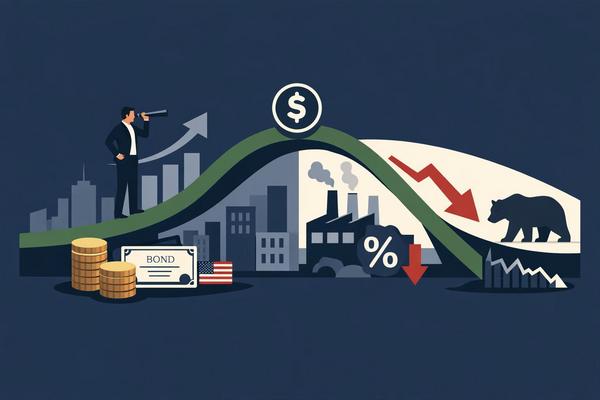
Your bills keep climbing, layoffs are back in the news, and you’re trying to figure out whether the economy is about to get worse.
If you’ve heard people mention an “inverted yield curve” like it’s some secret Wall Street alarm, here’s the plain-English version: it’s one of the strongest recession warning signs we’ve got.
Most people don’t follow the bond market, and honestly, you shouldn’t have to. But this one idea matters because it helps explain why economists, banks, and the Fed pay so much attention to Treasury yields when they’re trying to read where the economy is headed.
The short version is simple. Normally, long-term interest rates are higher than short-term ones. When that flips and short-term rates move above long-term rates, that’s called an inverted yield curve. And in modern US history, that kind of inversion has shown up before every major recession.
What the Yield Curve Actually Is
Think of the yield curve as a snapshot of interest rates on US Treasury debt at different time periods. You’ve got a 3-month Treasury bill, a 2-year note, a 10-year note, and a 30-year bond. Each one pays a different yield — basically the return investors get for lending money to the US government.
Most of the time, the curve slopes upward. A 10-year Treasury pays more than a 2-year Treasury, and a 2-year pays more than a 3-month bill. That makes sense because investors want more reward for tying up money for longer. A normal yield curve says the economy is expected to keep growing at a decent pace.
When the Curve Flips — and Why It Matters
When the yield curve inverts, that normal pattern breaks. Short-term Treasury yields rise above long-term yields. The 2-year Treasury might pay more than the 10-year. That’s the inversion people talk about on financial news.
Why does that happen? Usually because the Fed has raised short-term interest rates aggressively to cool inflation. That pushes up short-term yields fast. At the same time, investors start expecting slower growth, lower inflation later, and possible rate cuts down the road — so they buy longer-term Treasurys, which pushes those long-term yields down. The inversion is really the bond market saying, “Things look tight now, but weaker later.”
That matters because credit runs through the whole economy. Banks borrow and lend based on interest rate conditions. Businesses make hiring and investment decisions based on financing costs. Families feel it through mortgage rates, car loans, credit cards, and job security.
Why This Has Been Such a Strong Recession Signal
An inverted yield curve doesn’t cause a recession all by itself. It’s more like a warning light on your dashboard — you don’t blame the light for the engine problem, but you pay attention because something underneath the hood is off.
Here’s the pattern that keeps showing up: the Fed raises short-term rates to fight inflation, borrowing gets more expensive across the economy, investors start expecting weaker growth and lower rates in the future, the yield curve inverts, and months later the economy often rolls into recession.
It’s not perfect on timing, and that’s the part that frustrates people. The inversion can happen many months before a recession officially starts. Jobs may still be growing. Consumers may still be spending. The stock market may even rally. Then the slowdown shows up later — sometimes much later.
If You’ve Ever Wondered Why Nobody Talks About This
Part of the reason is simple: the bond market feels far away from everyday life. People pay attention to gas prices, rent, groceries, and their 401(k). They don’t wake up wondering what the 2-year Treasury is doing.
There’s also a bigger issue. A lot of economic signals only make sense after someone translates them into real life. “The 10-year minus 2-year spread turned negative” doesn’t mean much if you’re trying to decide whether to change jobs, buy a house, or build up savings. But once you understand that an inversion often signals tighter money now and weaker growth later, it becomes genuinely useful.
What This Can Mean for Your Money
You don’t need to turn into a bond trader. You just need to know what kind of environment an inverted curve usually points to. When the yield curve is inverted, it’s smart to think a little more defensively — not panicked, just sharper. That can mean building up your emergency fund if it’s thin, being more careful about taking on big new debt, keeping your resume updated especially if your industry is cyclical, and paying closer attention to your cash flow instead of only watching your investments.
If a recession does hit, the people in the best shape usually aren’t the ones who predicted the exact month — they’re the ones who gave themselves room to breathe before things got harder.
Does an Inversion Guarantee a Recession?
No signal is perfect, and the economy is messy. Government spending, consumer behavior, bank lending, global events, and Fed policy can all affect the timeline. Sometimes the slowdown takes longer than expected. Sometimes the labor market stays stronger than usual. Still, it’s a mistake to shrug off the signal just because it doesn’t work like a countdown clock. An inverted yield curve captures something real: investors collectively expect today’s high short-term rates to give way to a weaker economy later on. That doesn’t tell you the exact date of a recession, but it does tell you the risk is real.
The Warning Sign Most People Never See Coming
A lot of headlines treat recessions like they arrive out of nowhere — one day everything is fine, the next day companies are cutting jobs. Real life usually isn’t that clean. The warning signs tend to build quietly in places most people don’t watch, and the yield curve is one of those places. It’s not flashy, and it’s not the kind of thing your neighbors talk about over the fence. But it has a long track record, and that track record is why professionals keep coming back to it.
The yield curve matters not because it’s mysterious, but because it gives you a clearer way to see what may be coming before it hits your job, your budget, and your financial decisions. If this made sense, the next thing worth understanding is how the Fed’s rate decisions ripple into your savings account and mortgage payments.