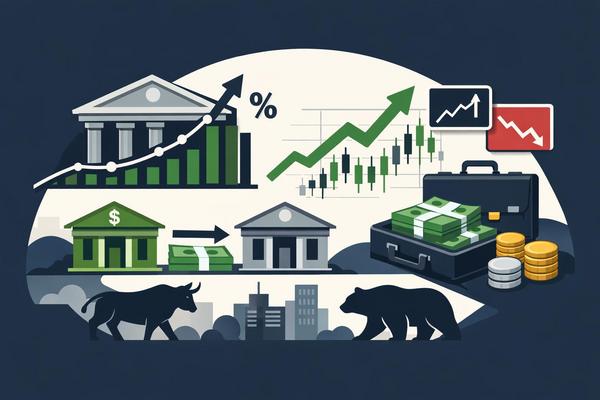
Your credit card rate jumped, your mortgage payment got uglier, and the stock market got weird — that’s the fed funds rate doing its thing.
If you’ve heard the Fed raise rates and thought, “Okay, but what does that actually change for me?” — you’re not alone.
The phrase federal funds rate sounds like something that only matters to bankers in D.C., but it reaches into regular life fast. Your credit card APR, your savings yield, your mortgage options — this one rate touches all of it.
The federal funds rate is the most powerful interest rate in America because it influences what banks charge, what you earn on savings, and how investors price just about everything else.
What the Federal Funds Rate Actually Is
It’s the interest rate banks charge each other for overnight loans.
Banks are required to keep a certain amount of money on hand. At the end of the day, some have extra while others come up short. They lend those reserves to each other — usually just overnight — and the rate on those loans is the fed funds rate.
You’re not borrowing at this rate yourself, and your bank isn’t handing you a car loan at this rate either. Still, this one overnight rate becomes the base signal for borrowing costs across the entire financial system. When the Fed wants to slow the economy down, it pushes this rate higher. When it wants to support borrowing, spending, and hiring, it cuts the rate. That’s why every Fed meeting gets so much attention.
Why Banks Care So Much About This One Number
Banks run on spreads. They borrow money, pay depositors, make loans, and try to earn the difference. If short-term money gets more expensive for banks, they usually pass that cost along.
That shows up in higher rates on credit cards, business loans, home equity lines, adjustable-rate mortgages, and plenty of other debt. Even fixed-rate loans like a 30-year mortgage don’t move one-for-one with the fed funds rate, but they still feel the pressure. Lenders look at the whole rate environment, inflation expectations, and recession odds.
When the Fed is raising rates aggressively, banks tend to get more cautious — tighter lending standards, stronger credit requirements, bigger down payments, fewer approvals for riskier borrowers. The fed funds rate doesn’t just change the price of borrowing. It changes who gets access to credit in the first place.
What Happens Inside a Bank When Rates Rise
A higher fed funds rate raises the cost of short-term funding, and banks have to decide how much to absorb and how much to push onto customers. Usually they respond in a few predictable ways:
- Variable borrowing rates go up almost immediately
- Lending standards get tighter
- Savings rates eventually rise — but usually more slowly than loan rates
- Demand weakens as households and businesses pull back
If you’ve ever noticed your credit card APR climb right away while your savings account barely budged, that’s not your imagination. Banks are faster to reprice debt than they are to reward savers.
Why Markets React Like the Fed Just Changed the Weather
In a way, it did. The fed funds rate sets the tone for money itself.
When money gets more expensive, investors start rethinking what future profits are worth today. That’s a big reason stocks often struggle when rates rise — especially fast-growing tech companies that depend on cheap borrowing. Higher rates also make safer assets like Treasury bills and money market funds more attractive. If you can earn a decent return on cash with less risk, stocks have to compete harder for your money.
Bonds react too. When rates rise, existing bonds with lower yields become less attractive, so their prices fall. Real estate feels it through mortgage costs and investor demand. Business investment slows because financing gets tougher. Consumers cut back because monthly payments eat up more of the budget. One Fed decision can ripple through stocks, bonds, housing, hiring, and your monthly bills all at once.
Why the Fed Uses This Tool in the First Place
The Fed has two big jobs: keep inflation under control and support maximum employment. Those goals can pull in opposite directions. If inflation is running hot, the Fed raises rates to cool spending and borrowing. If the economy is weak and unemployment is climbing, the Fed may cut rates to encourage lending and growth.
It’s not a precision instrument. It’s more like adjusting the thermostat in an old house — you make a move, then wait to see how the whole system responds. That delay is part of why Fed policy feels confusing in real time.
What This Means for Your Loans, Savings, and Paycheck
You don’t need to trade bonds for a living to use this. You just need to know where the fed funds rate tends to hit your life first.
If rates are rising, the most exposed parts of your financial life are variable-rate debt and new borrowing — credit cards, HELOCs, adjustable-rate loans, and some private student loans. If you’re carrying balances, more of your payment goes to interest instead of principal.
On the flip side, savers may finally see better yields on high-yield savings accounts, CDs, money market funds, and short-term Treasurys. Not instantly, and not equally, but better than during near-zero-rate periods.
For workers, rate hikes can cool hiring over time. Companies facing higher financing costs and slower demand may pull back on expansion. The job market often softens after borrowing stays expensive long enough — not overnight, but it adds up.
How to Use This in Real Life
You don’t need to predict the next Fed meeting. You do want to make smarter decisions based on the rate environment you’re already in.
- High-rate credit card debt becomes even more expensive to carry when rates are up — paying it down is one of the best moves you can make
- If you’re shopping for a loan, compare fixed and variable options carefully before signing anything
- If you’re sitting on cash, check whether your bank is actually paying a competitive yield — many aren’t
- If you’re investing, rate changes can hit prices short term without changing your long-term plan
- If you’re buying a home, focus on the full monthly payment, not just the listing price
Most people treat rate news like background noise. It’s not. It’s part of the price tag on everyday financial choices — from your grocery store credit card to your 401k balance.
The Simple Way to Think About It
The fed funds rate is the starting point for how expensive money is across the entire U.S. economy. When that starting point moves, banks change how they lend, consumers change how they borrow, and markets reprice risk fast.
It quietly shapes every loan, savings account, and market you touch — which makes it worth understanding even if you never set foot on Wall Street.
If this made sense, the next thing worth understanding is how the Fed’s rate decisions connect to inflation and what that means for your savings account.