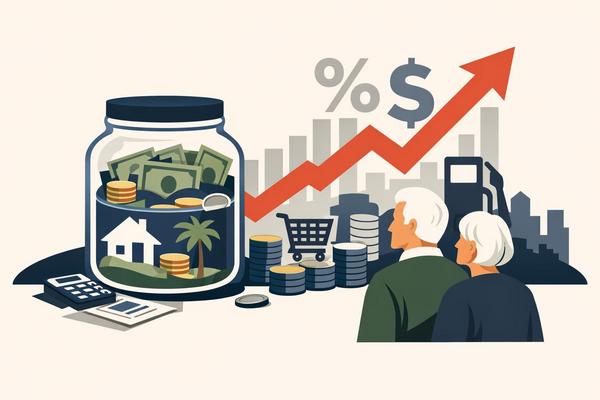
Your grocery bill is higher, your rent went up, and the retirement number you picked a few years ago may not cover the same life anymore.
You probably did what you’re supposed to do. You ran a retirement calculator, picked a target, and started working toward it. The problem is that a retirement savings goal isn’t fixed when the cost of living keeps moving.
If you came up with your goal five years ago, there’s a decent chance it’s already too low. That doesn’t mean you failed — it means inflation changed the math.
Your Old Retirement Target May Be Using Old Prices
Most people picture retirement in today’s dollars without realizing it. They think about what groceries cost now, what a dinner out costs now, what health insurance costs now — and then stretch that into the future. That works only if prices stay flat, and they don’t.
If you figured you’d need $60,000 a year to live on in retirement five years ago, that same lifestyle may cost significantly more now. Even moderate inflation adds up because it compounds. A 3% increase doesn’t sound brutal in one year, but over 10, 15, or 20 years, it changes what your money can actually buy. That’s the part people miss.
Retirement planning isn’t just about how long your money lasts. It’s also about what that money will be worth when you finally need to spend it.
Why Rising Costs Hit Retirement Planning Harder Than Regular Budgeting
When inflation shows up in your everyday life, you can cut back, switch stores, drive less, or skip upgrades. Retirement is different because you’re planning decades ahead — you’re not just covering next month’s bills, you’re trying to fund future spending at future prices.
That creates two separate inflation problems worth understanding.
Before Retirement, Inflation Raises the Size of the Goal
If your expected retirement lifestyle costs more than you assumed, your nest egg has to be bigger. Say you thought you needed $1 million because it would support roughly $40,000 a year using a conservative withdrawal rule. If the real spending need rises to $50,000 or $55,000, that same $1 million doesn’t stretch the same way. The account balance didn’t shrink — the buying power did.
Once You’re Retired, Inflation Keeps Chewing on Your Income
Even after you stop working, inflation doesn’t stop. You’ll still be paying more over time for food, utilities, property taxes, insurance, travel, and especially healthcare. A retirement plan that ignores rising costs can look fine on paper and still feel tight in real life. What feels comfortable at 65 may not feel comfortable at 75.
How Much Do You Really Need?
There’s no universal retirement number, and that’s exactly why broad advice can fall flat. Some people can live comfortably on less because their house is paid off and their spending is simple. Others need more because they rent, support family, travel often, or face high medical costs. The better question isn’t “What’s the magic number?” — it’s “What will my lifestyle actually cost when I retire?”
Build Your Estimate From Spending, Not From Headlines
Instead of chasing a round number like $1 million or $2 million, estimate what your real monthly life will cost. Use categories you already know from your current budget:
- Housing — whether that’s rent, mortgage, taxes, HOA dues, or maintenance
- Groceries and household basics
- Utilities, internet, and phone
- Gas, car insurance, repairs, or public transit
- Healthcare, prescriptions, and out-of-pocket costs
- Travel, hobbies, gifts, and eating out
- An emergency cushion for stuff you can’t predict
Then ask yourself: what will those costs likely look like by the time you retire? You don’t need perfect precision. You do need to stop assuming today’s prices will hold still.
A Quick Example That Shows the Gap
Say you want $70,000 a year in retirement income 15 years from now. If costs rise 3% a year, that same lifestyle would cost roughly $109,000 by the time you get there. Same retirement life — just at future prices. This is why people feel blindsided. They think they miscalculated their investment returns when the bigger issue was their spending assumptions.
What to Do If Inflation Already Blew Up Your Plan
You don’t need to panic, and you don’t need to scrap everything. You just need to update the plan with real numbers.
If you’re still working, even a 1% increase to your 401(k) contribution can help close the gap over time. Direct raises, bonuses, or side income toward retirement before that money disappears into everyday spending. Small adjustments now are a lot easier than a major catch-up move later.
Retirement planning also isn’t a one-and-done exercise. Prices change, your life changes, and markets move. Review your estimated retirement spending at least once a year and check whether your savings pace still matches reality. That one habit can keep an old number from quietly becoming a bad number.
And don’t ignore healthcare and housing — these are the two categories that can wreck a retirement estimate fast. Healthcare tends to rise faster than general inflation, and housing costs don’t disappear just because you retire. If you’ll still be renting, helping adult kids, paying property taxes, or dealing with repairs, build that in honestly. The easiest way to underestimate retirement is to assume your biggest bills will somehow stay tame.
The Real Goal Is Buying Power, Not a Milestone
Your retirement savings goal isn’t really about hitting a dramatic number. It’s about creating enough future buying power to support your life. A million dollars sounds the same in any year. What it can actually do for you does not.
The retirement number you calculated five years ago may already be too low — and now you know exactly why.
If this made sense, the next thing worth understanding is how Social Security fits into your total retirement income picture.