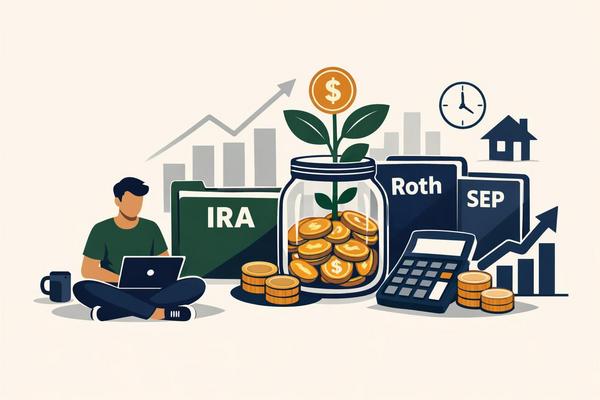
Your clients pay you, but nobody set up a 401k for you — and that makes retirement saving easy to put off.
If you’re self-employed, freelance, or piecing together income from contracts and side work, retirement usually lands at the bottom of the list. You cover rent, groceries, taxes, software, gas, maybe health insurance, and whatever’s left gets stretched across the month.
That doesn’t mean you’re bad with money. It means you don’t have the default system a regular job gives people. When someone works for an employer, retirement saving often happens in the background through payroll deductions and a company plan. When you work for yourself, nothing happens automatically unless you build it.
Not having an employer 401k doesn’t mean you can’t build retirement savings — it just means you have to set it up yourself.
Why Freelancers Fall Behind Without Realizing It
A lot of self-employed workers aren’t avoiding retirement on purpose. They’re dealing with irregular income, surprise tax bills, and months where business is solid followed by months that feel weirdly quiet. When your income changes all the time, long-term saving can feel less urgent than next month’s bills.
There’s also no HR department nudging you to enroll, no employer match making you feel like you’re leaving money on the table, and no paycheck deduction doing the work before you can spend the money. That missing structure matters more than people think. Most workers don’t become retirement savers because they woke up one day deeply interested in tax-advantaged accounts — they save because the system was already in place.
If you’re freelancing, driving for apps, consulting, designing, tutoring, writing, or running a small business, you need to create that structure on your own.
Your Main Retirement Account Options
You don’t need ten different accounts. You need to understand the few that actually make sense for self-employed workers without an employer plan.
The IRA: Simple and Easy to Open
An IRA is usually the most straightforward place to start. You open it yourself and contribute on your own schedule, as long as you stay within annual IRS limits. There are two common versions: traditional and Roth.
- Traditional IRA: contributions may give you a tax break now, and you pay taxes later in retirement.
- Roth IRA: you contribute after-tax money now, and qualified withdrawals in retirement are tax-free.
If your income is inconsistent and you’re just getting started, an IRA is often the easiest first move. It’s simple, flexible, and a lot less intimidating than people expect.
SEP IRA: Built for Higher Self-Employed Contributions
A SEP IRA is popular with freelancers and solo business owners who want to save more than a regular IRA allows. It’s funded by employer contributions, and when you’re self-employed, that employer is you. The rules are a little more specific, but the big appeal is the higher contribution limit compared with a standard IRA.
This can be useful in strong income years when you want to put away more and lower your taxable income. A SEP IRA tends to fit people whose income is solid enough that they want more room to save — it’s less about small monthly autopilot contributions and more about putting away a meaningful chunk when business cash flow allows.
Solo 401k: If It’s Just You
A solo 401k, sometimes called an individual 401k, is designed for self-employed people with no employees other than a spouse. It can let you contribute both as the employee and the employer, which creates more saving room — and for some freelancers, that makes it one of the most powerful options available. It can also come with more setup and administrative work than a basic IRA.
If you have good income and want to save aggressively, the solo 401k is worth a serious look. It’s especially useful for consultants, contractors, and one-person businesses that are earning enough to go beyond beginner-level contributions.
Which Account Makes the Most Sense for You?
You don’t need the perfect account on day one. You need an account you’ll actually use. Here’s a practical way to think about it.
- If you want the easiest starting point, look at an IRA.
- If your income is higher and you want larger contributions with simple business-focused rules, a SEP IRA may fit.
- If you’re self-employed with no employees and want the highest flexibility and contribution potential, a solo 401k may be the better tool.
The best retirement account is usually the one that matches the way your income actually works. If your pay swings month to month, flexibility matters. If you have a strong year and want to stash a lot away, higher limits matter. If paperwork stresses you out, simplicity matters.
How to Make This Work in Real Life
Knowing your options is useful. Actually funding the account is what changes your future. That’s where a lot of freelancers get stuck — they open an account, feel productive for a week, and then never contribute again.
Retirement saving works better when you treat it like one more business system, not a random good intention. A few habits can make this easier.
- Set a percentage, not a perfect dollar amount. Saving 5% or 10% of what comes in is often easier than promising a fixed monthly number.
- Move money after you get paid. When a client payment hits, send part of it to taxes and part to retirement before it gets absorbed into regular spending.
- Increase contributions in good months. Freelance income is lumpy, so your saving can be too.
- Automate whatever you can. Even a small recurring transfer helps create consistency.
- Keep short-term cash separate from retirement money. Emergency savings and retirement savings do different jobs.
You also don’t need to wait until you’re earning some magical six-figure freelance income. Starting small still counts. Putting away a modest amount now does more for you than planning to get serious later and never getting around to it.
You’re Not Locked Out — You’re Just in Charge
A lot of freelancers quietly assume they’re behind because they missed the normal path. No company 401k, no match, no benefits packet. That can make retirement feel like something built for salaried workers and not for you.
The real takeaway is that self-employed workers have retirement account options too, but they have to choose one and put a system around it. You may not have an employer doing the setup, but you still have access to tax-advantaged ways to invest for the future. Once you understand that, the whole question becomes a lot less mysterious.
If this made sense, the next thing worth understanding is how to balance retirement contributions with quarterly tax payments when your income changes every month.