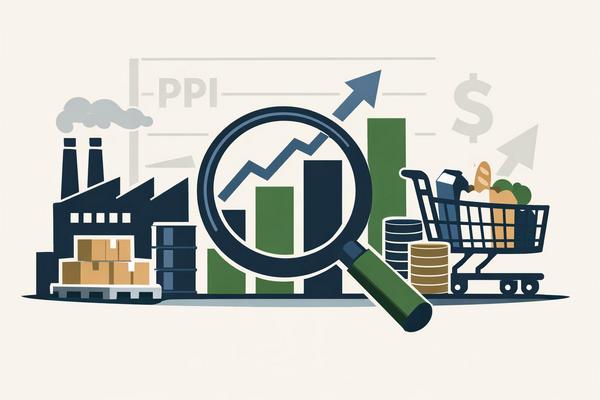
Your grocery bill is up, your rent costs more, and everyday basics keep getting harder to cover. If you’re trying to understand where inflation starts, the Producer Price Index — PPI — is one of the best places to look.
PPI tracks the prices businesses pay and receive before those costs ever show up at the checkout line. That matters because inflation usually doesn’t begin with you. It starts earlier, when manufacturers, wholesalers, and service providers start paying more for raw materials, shipping, labor, or equipment. Once those costs build up, businesses pass at least some of them along. That’s why PPI is treated as a leading indicator for consumer inflation.
Why Your Prices Usually Rise After Business Costs Do
You feel inflation when eggs, gas, insurance, or takeout get more expensive. Businesses feel it earlier — when steel costs more, freight rates jump, electricity gets pricier, or suppliers raise prices. By the time higher costs hit your wallet, companies have often been dealing with them for weeks or months.
Think about a loaf of bread. Farmers pay for fertilizer and fuel. Food processors pay for grain, packaging, and labor. Distributors pay for warehousing and trucking. Retailers pay for rent, refrigeration, and payroll. If costs rise early in that chain, consumer prices often move later — not instantly, and not always one-for-one, but often enough that PPI gives you an early read on where things are headed.
What PPI Actually Measures
PPI is published by the Bureau of Labor Statistics. It measures average changes over time in the selling prices domestic producers receive for their output — basically, what businesses are charging each other at different stages of production. CPI tells you inflation has reached the consumer. PPI can hint that it’s already on the way.
PPI data covers a wide range of categories, including goods like food, energy, metals, and machinery, services like transportation, warehousing, and finance, and construction and other business activity. You’ll also hear people talk about headline PPI versus core PPI. Headline includes everything. Core strips out food and energy because those prices swing around a lot month to month. Core isn’t always better, but it can make the underlying trend easier to read.
If PPI Spikes, Should You Expect Higher Prices Soon?
Often, yes — not perfectly, but often enough that investors, economists, and policymakers pay close attention. PPI leads CPI because businesses usually try to protect their profit margins when their own costs go up. Here’s the basic chain: input costs rise for producers, producers raise prices to wholesalers or retailers, retailers absorb some of the hit but not all of it, and consumer prices move higher later.
That said, pass-through isn’t automatic. Sometimes companies eat the cost because demand is weak. Sometimes competition is too intense to raise prices. Sometimes productivity improves and offsets higher input costs. Still, when PPI rises broadly and consistently — across goods, services, and multiple stages of production — it’s a solid warning sign that consumer inflation may follow.
Why the Timing Never Looks Perfectly Clean
People get tripped up expecting a neat one-month delay between PPI and CPI. Real life doesn’t work that way. Some costs pass through fast, like gasoline or food ingredients. Others take much longer, like rent, medical services, or durable goods. A shipping spike might hit retail prices within a few weeks. A wage increase in manufacturing might take months to show up in what you pay. That’s why one monthly report never tells the whole story — you’re better off watching the trend over several months.
When Higher Producer Prices Don’t Fully Reach You
Higher producer prices don’t always mean an equal jump in CPI. Businesses have options when costs rise: raise prices for customers, accept lower profit margins, cut other costs, use inventory bought at older prices, or wait to see if the increase fades. If companies think customers will stop buying, they may hold the line on prices even when PPI climbs.
Context matters here. If demand is strong, businesses have more room to pass costs through. If consumers are stretched and spending slows, companies may not be able to do that as easily. This is also why inflation can cool at the consumer level even when parts of PPI still look hot. The chain from producer costs to consumer prices is real, but it’s not mechanical.
How to Actually Use PPI in Your Life
You don’t need to trade bonds or build economic models for PPI to be useful. Think of it like an early weather report for inflation — it can help you spot pressure building before it fully reaches your monthly budget.
A few practical ways to use it: watch the three- to six-month trend rather than reacting to a single report, compare PPI with CPI to see whether business costs are starting to spill into consumer prices, and pay attention to broad increases rather than one jump in a single volatile category. If PPI is accelerating, that may be a heads-up to expect more pressure on groceries, household goods, repairs, or services down the road. It doesn’t mean panic — it means prepare. You might tighten your budget a little, delay a nonessential purchase, or keep more breathing room on your credit card for necessities. If PPI has been easing for several months, that’s often an early sign inflation pressure is cooling before CPI fully reflects it — though that usually means prices are rising more slowly, not actually dropping.
The Simplest Way to Think About It
If CPI tells you inflation has arrived, PPI tells you it may already be on the road. PPI measures what businesses pay before those costs reach you, which makes it one of the best early signals of where consumer inflation is headed. It’s not perfect, and it won’t predict every move in your grocery bill. But if you want to understand where inflation is going, PPI helps you look upstream instead of waiting until the damage hits your wallet.
If this clicked, the next thing worth understanding is how the Fed’s interest rate decisions ripple into your savings account and what that means for your money day to day.