Your credit card feels more expensive, your savings account still looks half-asleep, and every big purchase suddenly seems harder to justify.
If you’re trying to figure out what a Fed rate hike actually means for your money, you’re not alone. The headlines make it sound abstract, but it hits real life fast. One month you’re thinking about refinancing, replacing your car, or finally building an emergency fund. The next month, loan offers look worse, monthly payments jump, and everyone starts talking about “cooling demand.”
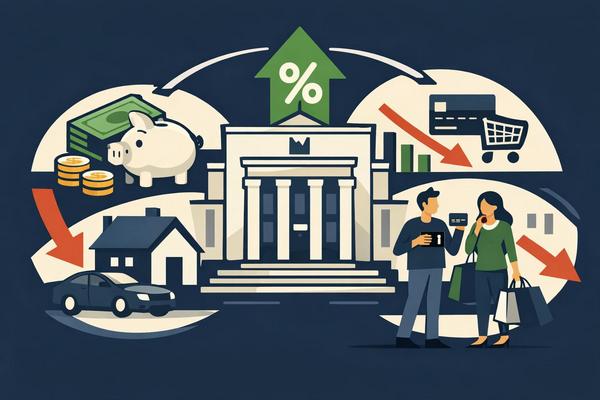
A Fed rate hike changes three things at once: borrowing gets pricier, saving gets more rewarding, and spending usually slows down.
Why the Fed Raises Rates in the First Place
The Federal Reserve usually raises interest rates when inflation is running too hot or the economy is growing faster than policymakers think is sustainable. In plain English, the Fed is trying to make money a little harder to use. When borrowing is cheap, people and businesses tend to spend more — pushing up demand for homes, cars, labor, travel, and everyday goods. If demand keeps outrunning supply, prices climb.
The Fed doesn’t directly set your credit card APR or your mortgage rate, but it strongly influences the short-term rates banks use and the broader direction of lending. That influence spreads outward through banks, bond markets, and consumer behavior — and eventually reaches your checking account, your debt, and the choices you make at the grocery store, the gas station, or the car dealership.
What Happens to Your Savings When Rates Go Up?
This is the part people hope for — and sometimes the part that takes longer than expected. When the Fed raises rates, banks can earn more on short-term assets, which creates room for them to pay savers more interest, especially on high-yield savings accounts, money market accounts, and CDs. Still, banks don’t all move at the same speed. Some raise savings rates quickly because they want deposits. Others drag their feet, especially if customers aren’t shopping around.
A rate hike can help savers, but only if your money is sitting in an account that actually passes those higher rates through to you. If your savings account is still paying next to nothing, the Fed hiking rates doesn’t do much for you personally. That’s why a lot of people hear “rates are up” and wonder why their balance isn’t earning more. The Fed moved, but their bank barely did.
In real life, here’s what this means:
- If you keep cash in a basic savings account at a big bank, your interest may rise slowly or barely at all.
- If you compare rates and move your cash, you may finally get a noticeable return on your emergency fund.
- If you’re nearing retirement or living on cash reserves, higher rates can make safe savings vehicles more useful than they were during the near-zero-rate years.
This doesn’t mean saving suddenly beats inflation every time. It just means your cash is no longer doing absolutely nothing.
Loans Get More Expensive — and Fast
This is where most people feel a rate hike first. Variable-rate debt usually reacts quickly — that includes many credit cards, home equity lines of credit, and some private loans. If your balance is revolving month to month, a Fed rate hike can quietly raise the cost of carrying that debt. Not by a dramatic amount overnight, but enough to matter over time.
Fixed-rate loans work differently. If you already locked in a 30-year mortgage or a fixed auto loan, your payment stays the same. But if you’re applying for a new loan, you’re walking into a more expensive market. A higher rate can mean a bigger monthly mortgage payment for the same house, a smaller car budget even if sticker prices haven’t changed, and more of your payment going to interest instead of principal — which leaves less room in your monthly budget for groceries, childcare, or your 401(k) contribution.
This is one reason rate hikes can cool the housing market. It’s not that everyone suddenly stops wanting a home. It’s that the monthly math stops working for a lot of buyers. The same logic applies to business loans — if companies have to pay more to borrow, some delay expansion, hiring, or equipment purchases, which slows the broader economy. That’s exactly part of the Fed’s goal.
When Spending Slows Before Your Bills Even Change
Not every effect shows up as a line item on your statement. Sometimes a Fed rate hike changes behavior before it changes your actual payment. People get more cautious when money feels tighter. They hold off on furniture, vacations, home projects, and other non-essentials. Businesses notice that hesitation and often pull back too.
If enough households start spending less, demand cools — which can help bring inflation down over time. It can also mean slower sales, weaker hiring, and shakier markets in the short run. Stocks may react because investors know higher rates can pressure company profits and make safer alternatives like bonds or cash more attractive. Housing can soften because affordability worsens. All of these are connected, and they all trace back to one decision by the Fed.
If You’re Trying to Adjust, Focus Here
You can’t control the Fed, but you can respond in a way that makes your finances more stable. The right move depends on whether you’re a borrower, a saver, or both.
If Debt Is Your Weak Spot
Take a hard look at variable-rate balances first. Credit card debt becomes more painful in a rising-rate environment because interest keeps stacking up faster. Paying down high-interest revolving debt usually gives you a better guaranteed return than chasing a slightly higher savings yield.
If Your Cash Has Been Sitting Idle
Check what your bank is actually paying. If the number is basically a rounding error, your money may be in the wrong place. Rate hikes only help savers who are positioned to benefit from them.
If You’re Planning to Borrow Soon
Run the monthly payment before you fall in love with the purchase. A lot of people still shop based on the price tag, but in a higher-rate environment, the payment is what bites — and even a modest rate increase can change the whole decision on a home, a car, or a personal loan.
The Bigger Picture Is Simpler Than It Sounds
The Fed isn’t just moving one number on a chart. It’s trying to steer the entire economy by making borrowing less attractive and saving a little more rewarding. That shift affects households unevenly. If you have a lot of cash and little debt, higher rates may help. If you’re carrying balances or trying to finance a big purchase, they can hurt quickly.
Borrowing costs rise. Saving yields improve. Spending slows. Markets adjust. That’s not four separate stories — it’s one story playing out across your wallet and the wider economy. Once you see that clearly, the news gets a lot easier to decode.
If this made sense, the next thing worth understanding is how inflation and interest rates push against each other over time — and what that cycle means for your paycheck and your savings.