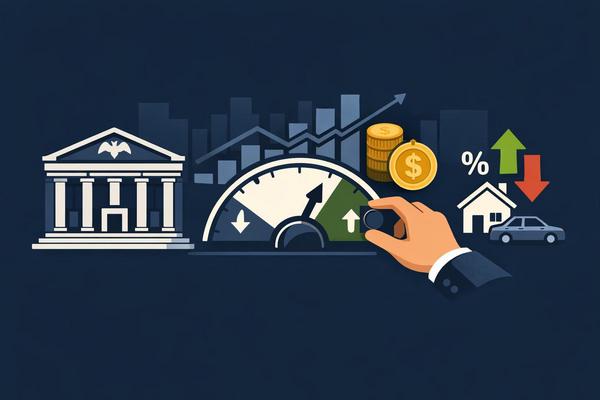
Your credit card rate is brutal, mortgage quotes keep shifting, and savings accounts suddenly look better than they did a year ago — and it all traces back to one institution making one decision.
If you’re trying to understand how the Federal Reserve sets interest rates explained simply, here’s the short version: the Fed doesn’t pick the rate on your car loan or mortgage by hand. What it controls is a key short-term rate that influences what banks charge each other, what banks pay to borrow, and how expensive money feels across the whole economy.
That one decision spreads outward into credit cards, savings accounts, business loans, hiring, home prices, and eventually your monthly budget.
What the Fed Is Actually Changing
When people say “the Fed raised rates,” they’re usually talking about the federal funds rate — the interest rate banks charge each other for very short-term lending, usually overnight. You never borrow at that rate yourself, but your bank lives in a world shaped by it. If that base cost of money goes up, borrowing gets more expensive across the system. If it goes down, money gets cheaper and easier to move around.
The Fed sets a target range for that rate, not one exact number, then uses its tools to push market rates into that range.
Why That Matters If You’re Not Running a Bank
Banks, lenders, investors, and businesses all react to the Fed’s moves. When their costs and expectations shift, your rates and your options shift too. That’s why a Fed meeting can affect things that seem unrelated at first — like whether you refinance, whether a company slows hiring, or whether your online savings account starts paying more.
How the Fed Pushes Rates Up or Down
The easiest way to think about it: the Fed controls the plumbing, not every faucet. It changes the conditions in the financial system, and the rest of the economy responds. Here are the main tools it uses:
- The federal funds target range: the Fed announces where it wants short-term rates to be.
- Interest on reserve balances: the Fed pays banks interest on money they park at the Fed, which sets a floor under rates.
- Overnight reverse repos: a tool that keeps short-term market rates from falling too low.
- Open market operations: the Fed buys or sells securities to add or drain money from the system.
You don’t need to memorize those. The practical point is that the Fed can make money tighter or looser. Tighter usually means higher rates, slower borrowing, and less spending. Looser usually means lower rates, easier borrowing, and more activity.
Why the Fed Does This in the First Place
The Fed’s two main jobs are keeping inflation under control and supporting a healthy labor market. Those goals can pull in opposite directions. If inflation is running hot, the Fed may raise rates to cool spending. If the economy is weak and layoffs are rising, it may cut rates to encourage lending and hiring. Rate changes are really the Fed pressing the gas pedal or the brakes on the economy — not perfectly, not instantly, but that’s the core idea.
If You’ve Ever Wondered Why Your Mortgage Doesn’t Move With the Fed
This is where a lot of people get tripped up. If the Fed raises rates by a quarter point, your 30-year mortgage rate doesn’t automatically rise by a quarter point the next morning. Mortgage rates are tied more closely to longer-term Treasury yields, inflation expectations, and investor demand — meaning they care about where markets think the economy is headed, not just what the Fed did today.
The same logic applies to other rates in your life:
- Credit cards usually react quickly because they often track the prime rate, which follows the Fed closely.
- Auto loans are influenced by both Fed policy and broader bond market conditions.
- Savings account rates may rise when the Fed hikes, but banks don’t always pass along the full benefit right away.
- Mortgage rates can actually move ahead of the Fed, or even fall after a rate hike, if markets believe inflation is finally cooling off.
People expect a clean one-to-one relationship. Real life is messier than that.
What This Looks Like at the Kitchen Table
When the Fed raises rates, borrowing tends to get more expensive — higher minimum payments on variable-rate debt, pricier home purchases, slower business expansion. But it can also mean better yields on savings accounts, CDs, and money market accounts. One Fed decision can hurt you on debt while helping you on cash savings at the exact same time.
When the Fed cuts rates, the opposite tends to happen. Debt may get cheaper, but savings yields often shrink. That’s why rate policy doesn’t feel universally good or bad — it depends on whether you’re mostly a borrower, a saver, a job seeker, a homeowner, or some mix of all of them.
Smart Money Moves to Keep in Mind
You don’t need to predict every Fed meeting. You just need to understand the direction of the ripple effects.
- If you carry credit card debt, pay close attention when rates are rising — variable APRs can climb fast.
- If you’re shopping for a home, watch mortgage trends, not just Fed headlines.
- If you’ve got cash sitting in a checking account, a higher-rate environment is a good reminder to compare savings yields.
- If you’re worried about your job, remember that aggressive rate hikes can slow hiring and business growth over time.
- If you’re refinancing or taking out a loan, timing matters — but your credit score and debt load still matter a lot too.
The Fed sets the weather. You still decide whether to bring an umbrella.
The Cleanest Way to Think About It
The Fed controls a starting point for the cost of money, and the rest of the financial system builds on top of that. Banks, bond markets, lenders, and investors all adjust based on what the Fed does and what they think comes next. That means the Fed doesn’t set your mortgage rate directly — but every decision it makes ripples into your rent, your debt, your savings, and your job market.
Once you see that, Fed news stops feeling like distant policy talk and starts looking like something that actually affects your life. If this made sense, the next thing worth understanding is how inflation changes what your paycheck can actually buy.