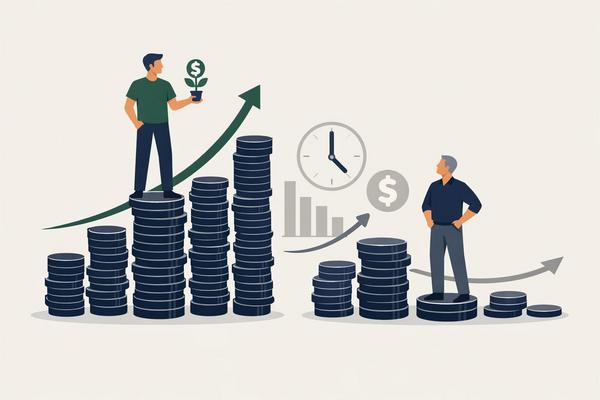
Your bills keep coming, retirement feels far away, and it’s easy to tell yourself you’ll start investing later — when you make more money, when things settle down, when the timing feels right.
That “I’ll do it when I make more money” idea gets expensive fast.
If you’re trying to figure out whether starting now really matters, the short answer is yes — a lot more than most people think. The reason is compound interest, which sounds boring until you see what it actually does over time. When you invest early, your money has years to grow, and then the growth starts earning growth too. That extra time can matter more than the total number of years you personally put money in.
In some cases, ten years of early investing can beat thirty years of late investing.
Why Starting Age Changes Everything
Most people think the winner is whoever invests the most money for the most years. That’s reasonable, but it’s not the whole story. The real driver is how long each dollar gets to stay invested.
A dollar invested at 25 has decades to compound before retirement. A dollar invested at 45 doesn’t. That gap matters because compound interest isn’t linear — it looks slow in the early years and then gets dramatically more powerful later. That’s why people underestimate it. The first few years feel unimpressive, kind of like watching water boil. Then, over enough time, the curve bends sharply upward.
You’re not just buying shares when you invest early — you’re buying time.
What Happens When You Run the Numbers
Let’s use a simple example. Assume both investors earn an average annual return of 8%, which is a common long-term stock market planning number. We’re not promising that return every year — we’re just using it to compare timing.
Investor A starts early, then stops
- Invests $6,000 a year from age 25 to 34
- Total years contributing: 10
- Total contributed: $60,000
- Then stops contributing completely
- Leaves the money invested until age 65
Investor B starts later and keeps going
- Invests $6,000 a year from age 35 to 64
- Total years contributing: 30
- Total contributed: $180,000
- Invests three times as much money overall
Now look at the ending value at age 65. Investor A ends up with about $773,000. Investor B ends up with about $680,000. The early investor put in $120,000 less and still finished ahead.
That’s not a trick. It’s what happens when the earliest dollars get forty years to grow instead of thirty, twenty, or ten. Those first contributions have the longest runway, and runway is everything with compounding.
What the Math Is Really Showing You
People usually focus on contribution totals because that’s the part they control directly. You can decide to save $100, $300, or $500 a month. Time feels less concrete, so it gets ignored. But in investing, time is doing a huge share of the heavy lifting.
Here’s the basic formula behind compound growth:
Future Value = Present Value × (1 + rate)^years
You don’t need to memorize that. Just notice one thing: the years are in the exponent. That’s what makes the difference explode over time. At 8%, $6,000 invested at age 25 can grow for 40 years — that one contribution alone becomes roughly $130,000 by age 65. The same $6,000 invested at age 45 grows for only 20 years and ends up around $28,000. Same dollar, same market return, totally different outcome because the clock started earlier.
This is also why waiting for the “perfect time” usually backfires. People delay because they want to pay off one more thing, land a better job, or just feel more financially stable. Those goals are understandable. Still, every year you wait gives compounding less room to work.
If You’re Starting Late, Don’t Panic
Seeing these numbers can make late starters feel like they missed the boat. That’s not the right takeaway. Yes, earlier is better. No, later isn’t pointless. If you’re 35, 45, or even 55 and you haven’t started, the worst move is using regret as an excuse to keep waiting.
Late investing still works — it just asks more from you. You may need to contribute more each month, retire a little later, or be more disciplined about lifestyle creep when your income rises. That’s not fun to hear, but it’s manageable. The math still improves the moment you begin. Even one year earlier is better than one year later.
If you’re in your 20s, your biggest advantage probably isn’t a high salary — it’s time. If you’re in your 30s or 40s, your advantage may be higher income and more stability, which can help you make up ground. If you’re close to retirement, the focus shifts from catching up perfectly to making smart decisions with the years you still have. The best age to start was earlier, but the next best age is the one you’re at right now.
How to Actually Use This
You don’t need a fancy spreadsheet habit to act on this. You need a simple routine and enough consistency to let time do its job.
- Start with an amount you can actually sustain every month
- Use tax-advantaged accounts like a 401(k) or IRA if they’re available to you
- Automate contributions so you’re not making the decision over and over
- When you get a raise, increase your contribution instead of upgrading every part of your life
- Leave the money invested instead of bailing every time the market gets ugly
That last one matters most. Compounding only works if the money stays in the game. Think of investing like planting trees — you don’t dig them up every few months to check whether they’re growing fast enough.
The Takeaway Most People Miss
When people compare investing early vs. late, they often assume discipline means contributing for as many years as possible. Discipline does matter. But the deeper lesson is that the earliest dollars are often the most valuable dollars you’ll ever invest — because compounding rewards time more than most people realize.
That doesn’t mean you need to be perfect. It means you should stop treating time like an unlimited resource in your financial life.
If this clicked for you, the next thing worth understanding is how dollar-cost averaging works when the market feels too expensive to buy into.