Your paycheck is already stretched, and now you’re supposed to figure out whether paying taxes now or later will save you more money.
You’re not really choosing between two investment accounts here.
You’re choosing when you want the IRS to take its cut.
That’s the difference between a Roth IRA and a traditional IRA in plain English.
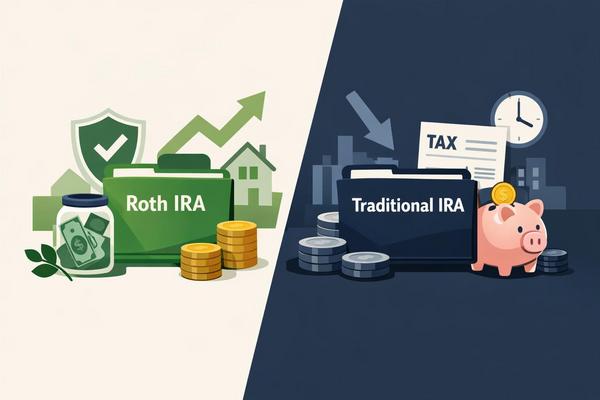
A traditional IRA can give you a tax break now, while a Roth IRA can give you tax-free withdrawals later. Everything else flows from that one tradeoff.
If you’ve been staring at both options and feeling like they sound almost the same, that’s normal. They’re both IRAs. They can both hold investments like index funds, ETFs, stocks, and bonds. They’re both built for retirement.
The real question is simple: is it better to pay taxes on this money today, or when you pull it out in retirement?
What’s the Actual Difference?
A Roth IRA is funded with money you’ve already paid taxes on. You don’t get a tax deduction when you contribute. In exchange, your money grows tax-free, and qualified withdrawals in retirement are tax-free too. That means if your investments grow for decades, the gains can come out without creating a tax bill later.
A traditional IRA works the other way. You may get a tax deduction for your contribution now, which lowers your taxable income this year. Your money still grows tax-deferred while it stays in the account. But when you withdraw it in retirement, you’ll owe ordinary income taxes on that money.
That’s why the usual shortcut is this:
- Roth IRA: pay taxes now, withdraw tax-free later
- Traditional IRA: get a tax break now, pay taxes later
That’s not just a cute summary. It’s the whole decision.
If Your Budget Is Tight Right Now
You might lean toward a traditional IRA because the current-year tax deduction can help. If you’re trying to cover rent, groceries, gas, and everything else, a tax break today may matter more than a cleaner withdrawal decades from now.
This is where traditional IRAs make emotional sense and math sense at the same time. Let’s say you’re in a higher tax bracket today than you expect to be in after you stop working — maybe your peak earning years are happening right now, or you expect retirement income to be lower because you’ll be living on Social Security and a smaller draw from savings. In that case, taking the deduction now and paying taxes later at a lower rate can work in your favor.
That said, there’s one catch people miss. Whether you can deduct a traditional IRA contribution depends on your income and whether you’re covered by a workplace retirement plan like a 401(k). You can contribute either way, but the deduction may be limited or disappear at certain income levels.
When a Roth Starts Looking Better
A Roth IRA often makes more sense if you think your tax rate will be higher later. Maybe you’re early in your career and not earning your peak income yet. Maybe your income is relatively low this year. Maybe you just like the idea of locking in today’s tax rate instead of gambling on what Congress might do 20 or 30 years from now.
There’s also a flexibility angle. Because Roth contributions are made with after-tax dollars, you can generally withdraw your contributions — not earnings — without tax or penalty. That doesn’t mean you should use a Roth like a checking account. Retirement money works best when you leave it alone. Still, that feature makes some people feel more comfortable starting with a Roth, especially if they’re nervous about locking money away forever.
Another plus: Roth IRAs don’t have required minimum distributions during the original owner’s lifetime. Traditional IRAs do. If you like the idea of giving your money more time to grow on your terms, that matters.
Which One Actually Fits You?
If you want the shortest honest answer: choose based on whether your tax rate is likely lower now or lower in retirement. You don’t need a perfect prediction — just a reasonable one.
A Roth IRA usually makes more sense if:
- You’re in a lower tax bracket now
- You expect to earn more later in your career
- You want tax-free income in retirement
- You like the idea of no required minimum distributions
- You can afford to give up the tax deduction today
A traditional IRA usually makes more sense if:
- You want a tax deduction now
- You’re in a higher tax bracket today
- You expect your retirement tax rate to be lower
- You need more breathing room in your current budget
- You value lowering this year’s taxable income
There’s also a middle-ground answer people forget. You don’t have to treat this like a permanent identity test. One year, a Roth might make more sense. Another year, a traditional IRA might. If your income changes, your job changes, or your tax picture shifts, the better choice can shift too.
A Few Real-Life Scenarios
Say you’re 26, renting an apartment, earning $55,000, and expecting your income to rise over time. You’re probably not at your lifetime peak tax rate yet. Paying taxes now may sting less than paying them later on a much larger retirement balance. That’s a classic Roth IRA setup.
Now picture someone in their late 40s earning $140,000, already maxing out a 401(k), and looking for another tax break. If they expect lower taxable income in retirement, a traditional IRA starts to look more attractive — assuming they qualify for the deduction.
Or say your income is unpredictable because you’re self-employed. In a high-income year, the deduction from a traditional IRA may feel especially useful. In a lower-income year, a Roth contribution may be the smarter move. The better account depends on your tax timing, not some fixed rule.
Still Not Sure? Here’s a Simple Way to Think About It
Most people don’t know what their future tax rate will look like. That’s fine. When the future is fuzzy, ask yourself which tax hit hurts less right now. If paying taxes now feels manageable and you like the idea of tax-free withdrawals later, Roth is often the cleaner choice. If cash flow is tight and a deduction would help this year, traditional may be the better fit.
Also, don’t let the account decision distract you from the bigger win. Choosing between Roth and traditional matters — but actually contributing matters more. An okay choice you fund consistently beats the perfect choice you keep putting off.
The choice between a Roth and a traditional IRA really does come down to one question: when do you want to pay taxes? Once that clicks, the next thing worth understanding is how a 401(k) fits into the picture and where each account belongs in your overall retirement plan.