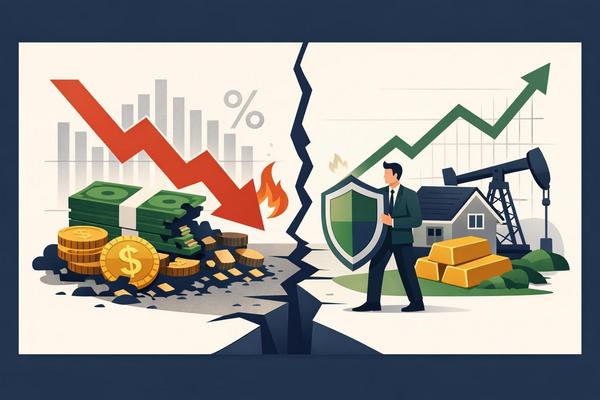
Your grocery bill is higher, your rent went up, and your paycheck didn’t move much — that same squeeze can quietly hit your investments too.
Inflation Doesn’t Just Hurt Your Budget
Most people notice inflation at the store long before they notice it in their portfolio. You see it when eggs cost more, gas jumps again, or your landlord raises the rent. What’s easier to miss is that inflation also changes what your investment returns are actually worth. If your account goes up 5% in a year while inflation runs at 4%, you didn’t really gain much buying power. On paper, you made money. In real life, you barely moved forward. That gap between what you earn and what your money can still buy is the part a lot of investors underestimate.
A rising account balance can make you feel like your plan is working fine. But if the cost of food, healthcare, insurance, and everything else keeps climbing faster than your returns, your money is losing strength over time. It doesn’t always wipe you out in one dramatic move. It slowly chips away at your progress.
What Inflation Is Actually Doing to Your Returns
Inflation erodes investment returns by shrinking your real return — and that’s the number that actually matters. Your nominal return is the number you see on your statement. Your real return is what’s left after inflation. That’s the number tied to your future lifestyle, not just your account value.
Here’s a simple example. If your investments earn 7% over a year and inflation is 3%, your real return is roughly 4%. If inflation jumps to 6%, that same 7% return only leaves you about 1% in real terms. You’re still technically ahead, but not by much. And if your money is sitting in cash earning 1% while inflation is running at 4%, you’re going backward even though the dollar amount didn’t fall.
This hits conservative savers especially hard. A lot of people think they’re being careful by parking too much money in low-yield savings, money market accounts, or bonds with fixed payments. There’s nothing wrong with playing it safe for short-term needs. The problem is using short-term tools for long-term goals. When inflation sticks around, fixed income streams and low rates can lose purchasing power fast.
Why Inflation Risk Doesn’t Feel Like Risk
Inflation risk doesn’t always feel like risk because it’s not as obvious as a market crash. When stocks fall 20%, everybody notices. When inflation takes 3% to 5% of your purchasing power year after year, it’s quieter — still painful, just quieter. A portfolio built only to avoid volatility can still fail you. If your strategy protects you from short-term price swings but leaves you exposed to long-term loss of buying power, it may feel safe while doing real damage.
Which Assets Tend to Hold Up Better
No investment is a perfect inflation shield, but some assets have a much better track record than others. The key is to own things that can either grow with the economy, adjust with inflation, or produce income that has room to rise over time.
Stocks: Messy in the Short Run, Useful in the Long Run
Stocks aren’t a straight-line hedge against inflation every single year. In fact, inflation spikes can pressure stock prices for a while. But over long periods, stocks have historically been one of the better ways to outpace inflation. That’s because businesses can often raise prices, improve earnings, and grow along with the broader economy. Companies with strong pricing power tend to hold up better than businesses that can’t pass costs along. Broad index funds are usually the easiest way for regular investors to get this exposure without trying to pick winners.
TIPS and I Bonds: Built With Inflation in Mind
Treasury Inflation-Protected Securities, or TIPS, are government bonds designed to adjust with inflation. Their principal value rises with the Consumer Price Index, which helps protect your purchasing power better than a standard bond does. I Bonds work differently, but they also have inflation-linked features and are government-backed. They come with rules and purchase limits, so they’re not a complete portfolio solution — but they can make sense for a portion of your safer money. Assets like TIPS and I Bonds can help defend the part of your portfolio that isn’t meant for big growth.
Real Estate and Real Assets
Real estate can also offer some inflation protection. Rents can rise over time, and property values often move with replacement costs and income potential. That doesn’t mean real estate is automatically safe or cheap — it still depends on location, debt, timing, and what you paid. But as an asset class, it has characteristics that can hold up better than cash when inflation runs hot. Commodities sometimes benefit from inflation too, though they can be volatile and hard to rely on for long-term wealth building on their own. They may play a supporting role. They usually shouldn’t be the whole strategy.
What This Looks Like in a Real Portfolio
You don’t need to build some extreme inflation bunker to invest wisely. You just need to stop assuming that any positive return is good enough. A smart portfolio usually balances growth, stability, and inflation awareness.
For most people, that means thinking in buckets. Keep cash for emergencies and near-term bills. Use bonds and inflation-linked assets for stability. Use stocks for long-term growth that has a real chance to outrun inflation over the years. That mix will depend on your age, goals, and timeline, but the principle stays the same. Your money needs different jobs, and not every dollar should be invested the same way.
A Quick Way to Check Yourself
Ask a simple question: if inflation averages 3% and your portfolio earns 4%, are you really making enough progress for retirement, your kids’ college, or future living costs? Maybe. Maybe not. It depends on taxes, fees, and how long you need that money to work. The real test is whether your portfolio is growing your future buying power — not just your statement balance. That’s the lens that helps you make better decisions and keeps you from being fooled by returns that look fine but don’t carry enough weight in the real world.
- Compare your returns to inflation, not just last year’s account growth
- Don’t hold too much long-term money in cash or low-yield accounts
- Use stocks for growth and consider TIPS or I Bonds for protection
- Match your investments to your timeline instead of reacting to headlines
The Bottom Line
Inflation doesn’t just raise prices — it quietly eats your investment returns if your portfolio isn’t positioned to keep up. Investing against inflation isn’t about chasing whatever asset is hot this year. It’s about building a mix that gives your money a real chance to preserve and grow purchasing power over time. If you ignore that, your portfolio can look healthy while your future gets more expensive.
If this made sense, the next thing worth understanding is how interest rates affect what happens to your stocks, bonds, and savings account.