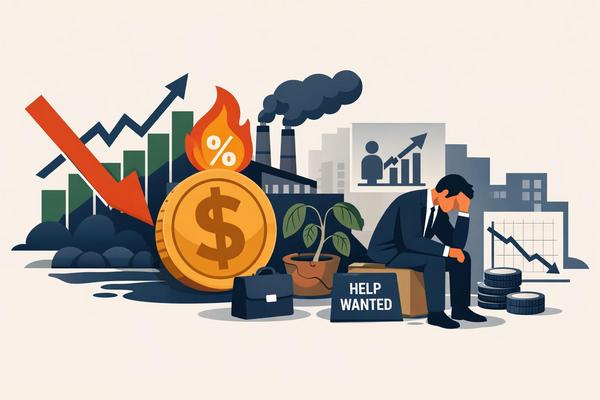
Your groceries cost more, job openings are drying up, and the economy still isn’t growing much — that’s not just a rough patch. That’s what stagflation looks like up close.
What stagflation actually means
Stagflation is when high inflation, slow economic growth, and rising unemployment all show up at the same time. That mix is what makes it different from a normal inflation problem or a normal recession.
Usually, when the economy slows down, inflation cools off too. Or when inflation is running hot, it’s often because the economy is strong and people are spending freely. Stagflation breaks that pattern. Prices keep climbing even while businesses pull back, hiring weakens, and people feel less secure about their jobs.
The word itself is a mash-up of “stagnation” and “inflation,” and the name tells you the whole story.
Why This Hits So Hard in Real Life
Stagflation hits both sides of your life at once: your bills go up while your income options get worse.
Inflation alone is painful because your paycheck buys less. A slow economy alone is stressful because raises dry up and layoffs become more likely. Put them together and you get the worst of both worlds. Rent goes up. Gas stays expensive. Groceries take a bigger bite out of every paycheck — and at the same time, companies get more cautious, freeze hiring, cut hours, or start trimming staff.
That leaves you paying more while feeling less certain about your job. For a lot of households, that’s when credit card balances start creeping up. Not because people are splurging, but because they’re just trying to cover the basics.
How Do You Get Inflation and Unemployment at the Same Time?
Stagflation usually shows up when the economy gets hit on the supply side, not just the demand side. In plain English, that means the country can’t produce or deliver goods and services as smoothly or cheaply as before — think oil shocks, supply chain breakdowns, wars, or sudden jumps in what it costs businesses to operate.
If the cost of energy, transportation, raw materials, or labor rises fast, companies face two bad choices: raise prices or absorb the hit and watch profits shrink. Most do some of both. That pushes inflation higher. At the same time, those higher costs can slow production, delay investment, and weaken hiring. Consumers pull back because everything costs more. Businesses pull back because demand looks shaky and expenses are rising. That’s how inflation and unemployment end up moving in the wrong direction together.
A simple way to picture it
Imagine a trucking company paying a lot more for fuel, repairs, and wages. It raises delivery prices to survive. Stores raise prices because shipping got more expensive. Shoppers buy less because their budgets are tighter. The trucking company now has higher costs and weaker demand, so it cuts routes and stops hiring. Prices are still high, but growth slows and jobs weaken. That’s stagflation in miniature.
The Fed’s Problem: Every Fix Makes Something Else Worse
The Federal Reserve mainly fights inflation by raising interest rates. Higher rates make borrowing more expensive, which cools spending on homes, cars, business expansion, and anything people finance with debt. When that works, inflation starts to ease. The problem is that slower spending also means slower hiring and more unemployment.
Flip it around, and you’ve got the same trap from the other side. If the Fed cuts rates to support growth and jobs, it makes money cheaper and encourages more borrowing and spending. That can help the labor market — but it can also pour fuel on inflation, especially if the original problem was supply-driven and never really got fixed.
Fight inflation and you risk a weaker job market. Support jobs and you risk even higher prices. In a normal slowdown, the Fed can cut rates and help. In a normal inflation surge, it can raise rates and cool things off. Stagflation scrambles that playbook entirely.
Why everyone keeps bringing up the 1970s
The 1970s are the classic American example. Oil shocks drove up energy prices, and that cost flowed through the entire economy — from manufacturing to transportation to household utility bills. The Fed struggled because there was no clean solution. Tightening policy hurt the economy. Backing off risked letting inflation get even more entrenched. That’s why stagflation still gets so much attention today. It’s not just an economics term. It’s a warning about a situation where the usual policy tools don’t work neatly.
What Stagflation Means for Your Money
You can’t control the Fed, global energy markets, or whether companies start cutting jobs. What you can control is how exposed you are if prices stay high and income gets less reliable. That usually means going back to basics:
- Watch your fixed monthly costs closely — especially housing, car payments, and high-interest debt.
- Build up a cash cushion if you can, because job markets can soften fast.
- Be careful with variable-rate debt and new borrowing when rates are high.
- Stress-test your budget for higher grocery, utility, and insurance costs.
- Keep your job skills current, especially if your industry is sensitive to slowdowns.
This isn’t about panic. When prices rise and job security weakens at the same time, financial flexibility matters a lot more than making bold investment moves.
The definition is simple. The policy problem isn’t.
Stagflation means high inflation, slow growth, and rising unemployment all hitting at once — and that’s exactly why it worries both economists and everyday Americans. It squeezes households because costs stay high while the economy loses momentum. And it squeezes the Fed because its main tools pull in opposite directions. Raise rates, and inflation may cool but unemployment can get worse. Cut rates, and jobs may get support but inflation can flare back up.
Stagflation isn’t just “inflation plus a bad economy.” It’s a situation where the usual fixes come with ugly tradeoffs, which is why the Fed can end up looking stuck.
If this clicked, the next thing worth understanding is how the Fed’s rate decisions ripple into your savings account, mortgage rate, and credit card interest.